Smokeless Indoor Grills in 2026: Watts, Plates, Real Sear
Which smokeless indoor grill actually sears? We compare wattage, plate material, and smoke control from owner feedback to find the best indoor grill for apartments in 2026.
Reader-supported: we may earn a commission from links on this page, at no extra cost to you. It never affects our picks. Learn more.
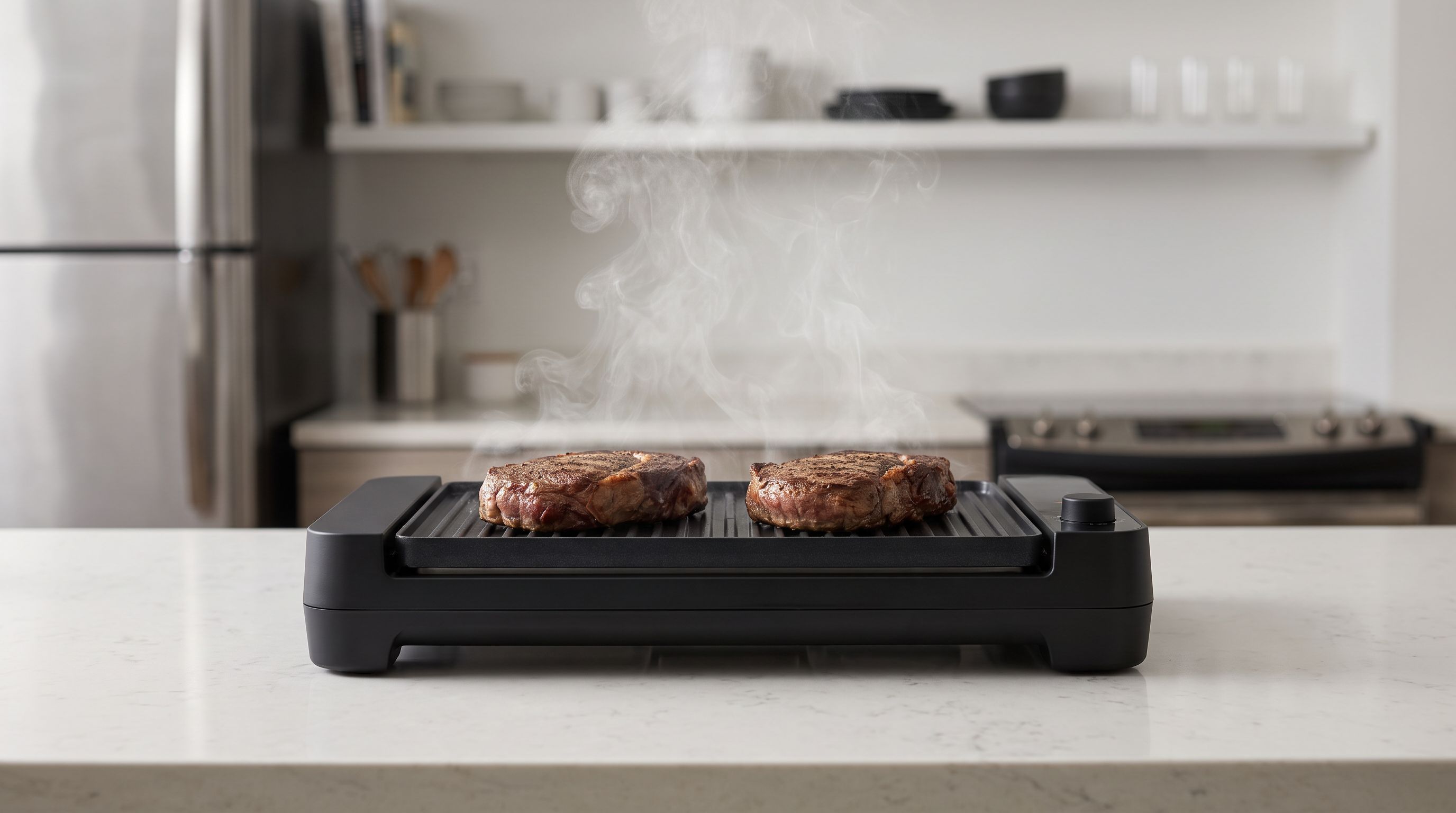
"Smokeless" is marketing shorthand, not physics. Any grill hot enough to brown a ribeye will vaporize some fat, and that vapor is smoke. What a good indoor grill does is manage it: keep the drip zone cool so rendered fat never hits the element, pull vapor through a fan and filter, or simply put a lid between your steak and your smoke alarm.
That reframing matters because it explains why so many apartment cooks are disappointed. They buy a 1,200-watt unit, cook a well-marbled steak at max setting, and set off the detector anyway. The fix isn't a different brand — it's understanding how watts, plate material, and drip design interact.
Watts Are the Sear Ceiling
Browning starts in earnest above roughly 300°F at the food surface, and you want plate temperatures in the 400–450°F range to get a crust before the interior overcooks. Wattage determines two things: how high the plate can climb, and — more importantly — how fast it recovers after cold food lands on it.
Most countertop grills in 2026 sit between 1,200 and 1,800 watts on a standard 120V circuit. Here's the practical read:
- Under 1,200W: Fine for burgers, chicken, vegetables, paninis. Expect gray edges on steak rather than a crust, especially if you crowd the plate.
- 1,200–1,500W: The sweet spot for most households. Enough recovery for two steaks or four burgers at a time.
- 1,500W and up: Real searing, but you're close to the 15-amp circuit limit. Don't run one on the same breaker as a toaster or microwave.
A useful trick regardless of wattage: preheat at least 8–10 minutes, not the 3–5 the manual suggests. Thermal mass in the plate matters more than the readout, and most units flash "ready" long before the metal is saturated with heat.
Plate Material Changes How Food Browns
This is where units genuinely differ, and where spec sheets are vague.
Cast aluminum with nonstick coating is the most common. It heats fast, weighs little, and releases food reliably. The downside is thermal mass: thin aluminum plates dump heat the instant cold protein hits them, which is why cheap grills steam rather than sear. Nonstick also degrades above about 450°F over time, which is one reason manufacturers cap temperatures.
Cast iron, enameled or bare, holds heat far better and gives the deepest crust and sharpest grill marks. It's heavier, slower to preheat, and usually not dishwasher-safe. The Zojirushi Indoor Electric Grill EB-CC15 uses a heavy cast plate approach and is widely regarded as the best browning performer among open-grate indoor grills.
Stainless or coated steel griddles are common on hybrid units. Flat griddle surfaces actually brown better than ribbed plates — more contact area — even though they look less "grilled." If crust matters more than stripes, griddle mode is often the better choice.
Ribbed vs. flat is the quiet tradeoff. Ribs create the classic marks and let fat drain away, which is the smoke-control mechanism on most open grills. But only the ridge tops touch the food, so maybe 30% of the surface is doing the browning. Flat plates brown everything but pool fat — fine if there's a grease channel, smoky if there isn't.
How Smoke Control Actually Works
Three approaches dominate, and owner feedback after a year of use separates them clearly.
Cool-zone drip tray (water-filled or offset). Fat drips past the element into a tray below, often with water added. This is the Philips Smokeless Indoor Grill approach and it works genuinely well — owners consistently report minimal smoke even with fatty cuts. The catch is cleanup and the need to actually use the water.
Powered extraction. A fan pulls vapor through a mesh or carbon filter, as on the Ninja Sizzle and the discontinued-but-still-circulating Ninja Foodi Grill line. Effective for moderate smoke, less so for a fatty ribeye at max heat. Filters need washing; owners who skip this report performance falling off within months.
Lid containment. Contact grills like the Cuisinart Griddler and T-fal OptiGrill close over the food, trapping most vapor. The least glamorous solution and arguably the most reliable in a small apartment.
Realistic expectation: with any of these, a lean chicken breast or vegetables will produce near-zero visible smoke. A 1.5-inch ribeye at full heat will produce some, every time. Crack a window and turn on the range hood.
The Picks
| Model | Approx. power class | Plate type | Smoke strategy | Best for |
|---|---|---|---|---|
| Zojirushi Indoor Electric Grill EB-CC15 | ~1,300W | Heavy cast, nonstick coated | Cool-zone drip pan below plate | Best sear and marks; yakiniku-style cooking |
| Hamilton Beach Electric Indoor Searing Grill | ~1,200–1,400W | Nonstick cast aluminum, ribbed | Lid containment + water drip pan | Value; lid traps smoke and speeds cooking |
| Philips Smokeless Indoor Grill | ~1,600W class | Ribbed nonstick plate over IR element | Reflective cool drip tray | Lowest smoke output with fatty cuts |
| Cuisinart Griddler GR-4N | ~1,500W class | Reversible grill/griddle plates | Closed-lid contact cooking | Versatility: panini, griddle, contact grill |
| Ninja Sizzle Smokeless Indoor Grill | ~1,500W class | Flat nonstick griddle plate | Enclosed design, low-splatter | Flat-top browning for smash burgers and breakfast |
 Best flat-top · Ninja Sizzle Smokeless Indoor Grill — Check price on Amazon →
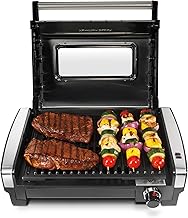 Best value · Hamilton Beach Electric Indoor Searing Grill — Check price on Amazon →
 Best overall · Zojirushi EB-CC15 Indoor Electric Grill — Check price on Amazon →
Zojirushi Indoor Electric Grill EB-CC15 — best overall. It is the simplest unit here: a dial, a plate, a pan. No app, no presets. What it does is hold heat through a cold ribeye better than nearly anything else at this size, and it's the unit most often cited by reviewers who care specifically about browning. The plate is dishwasher-safe and the footprint suits a small table for cook-at-the-table meals.
Hamilton Beach Electric Indoor Searing Grill — best value. Repeatedly named best overall or best value across 2026 roundups for good reason. The hinged lid is the whole trick: it reflects heat down (cutting cook times) and keeps vapor inside. The nonstick plate is removable and dishwasher-safe. It will not out-sear the Zojirushi, but for burgers, chicken thighs, and vegetables it's hard to argue with.
Philips Smokeless Indoor Grill — best smoke control. The infrared element and reflective drip tray mean fat never contacts a hot surface. Owners cooking bacon and fatty sausage indoors consistently rate it the quietest performer on smoke. It's a larger, pricier machine, and the plate is ribbed, so crust is good rather than great.
Cuisinart Griddler GR-4N — most versatile. Reversible plates give you grill, griddle, panini press, and open-flat full griddle. For an apartment where counter space is scarce, replacing three appliances is a stronger argument than a marginally better steak.
Ninja Sizzle Smokeless Indoor Grill — best flat-top. A flat griddle plate with full contact browning, aimed at smash burgers, breakfast, and stir-fry-style cooking. If you've concluded that grill marks are decoration and crust is the point, this is the design that matches.
What to Skip
Anything advertising "no smoke ever" with a sub-1,000W element and a thin stamped plate. Those are indoor griddles with aspirational packaging — they steam chicken and gray out steak. Also skip multi-function "food stations" with four shallow zones unless you genuinely cook for a crowd; each zone is underpowered.
FAQ
Can a smokeless indoor grill really sear a steak? Yes, with caveats. Preheat 10 minutes, pat the meat bone-dry, use a cut under 1.25 inches, and cook one or two pieces at a time. A heavy-plate unit like the Zojirushi gets closest to cast-iron results.
Will it set off my smoke alarm? Lean proteins and vegetables, rarely. Fatty cuts at high heat, possibly. Use the range hood, open a window, and add water to the drip tray if your model supports it.
Do the filters on fan-based grills need replacing? Most use washable mesh or sponge filters rather than consumables. Wash them after every few fatty cooks — owner complaints about declining smoke performance almost always trace back to a clogged filter.
Grill plate or griddle plate for browning? Griddle. Full surface contact means more Maillard reaction. Ribbed plates drain fat better and look the part, which is why most "smokeless" units use them.
Is nonstick coating a problem at searing temperatures? Keep it under about 450°F, never use metal tools, and hand-wash when possible. Coating failure from overheating is the single most common one-year complaint across every brand.
Our picks
Zojirushi EB-CC15 Indoor Electric Grill
Heavy cast plate holds heat through cold steak better than almost any countertop grill its size.
Hamilton Beach Electric Indoor Searing Grill With Lid & Viewing Window
Hinged lid traps smoke and speeds cooking; removable dishwasher-safe nonstick plate.
Philips Smokeless Indoor Grill
Infrared element plus reflective cool drip tray keeps fat off hot surfaces — minimal smoke with fatty cuts.

Cuisinart Griddler 5-in-1 Electric Indoor Grill and Panini Press, GR-4NNAS
Reversible grill and griddle plates cover contact grilling, panini, and full flat-top in one footprint.
Ninja Sizzle™ Indoor Grill & Griddle, 14'', 500°F, Grey/Silver, GR101
Full-contact griddle plate browns smash burgers and breakfast better than any ribbed surface.
Get the best kitchen gear deals in your inbox
Join the PrepDeck newsletter for hand-picked kitchen gear deals and new buying guides. No spam, unsubscribe anytime.
Related reads
Convection Microwaves in 2026: 5 Picks by Cubic Feet
The best convection microwave 2026 picks compared by interior cubic feet, turntable diameter and external footprint — so you know what actually fits your counter.
Countertop vs Over-the-Range Microwave: Fit First in 2026
Countertop vs over the range microwave in 2026: compare cavity size, venting CFM, 30-inch cutouts, clearance rules and long-term reliability before you buy.
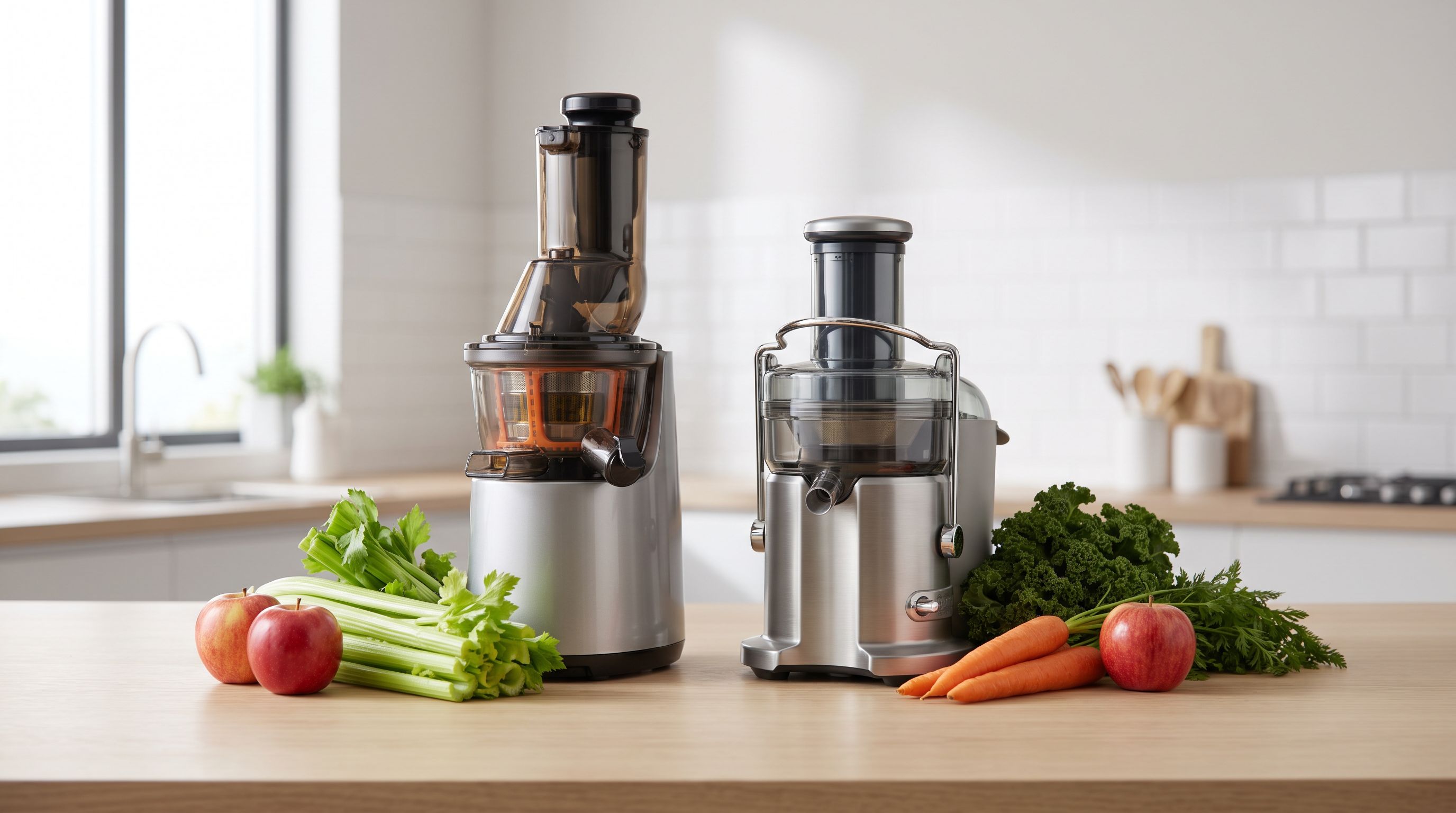
Auger vs Centrifugal: The Best Juicer 2026 Buyers Argue Over
Auger or centrifugal? We compare torque, feed chute size, pulp dryness and cleanup to help you choose the best juicer 2026 has for your produce and counter space.