Auger vs Centrifugal: The Best Juicer 2026 Buyers Argue Over
Auger or centrifugal? We compare torque, feed chute size, pulp dryness and cleanup to help you choose the best juicer 2026 has for your produce and counter space.
Reader-supported: we may earn a commission from links on this page, at no extra cost to you. It never affects our picks. Learn more.
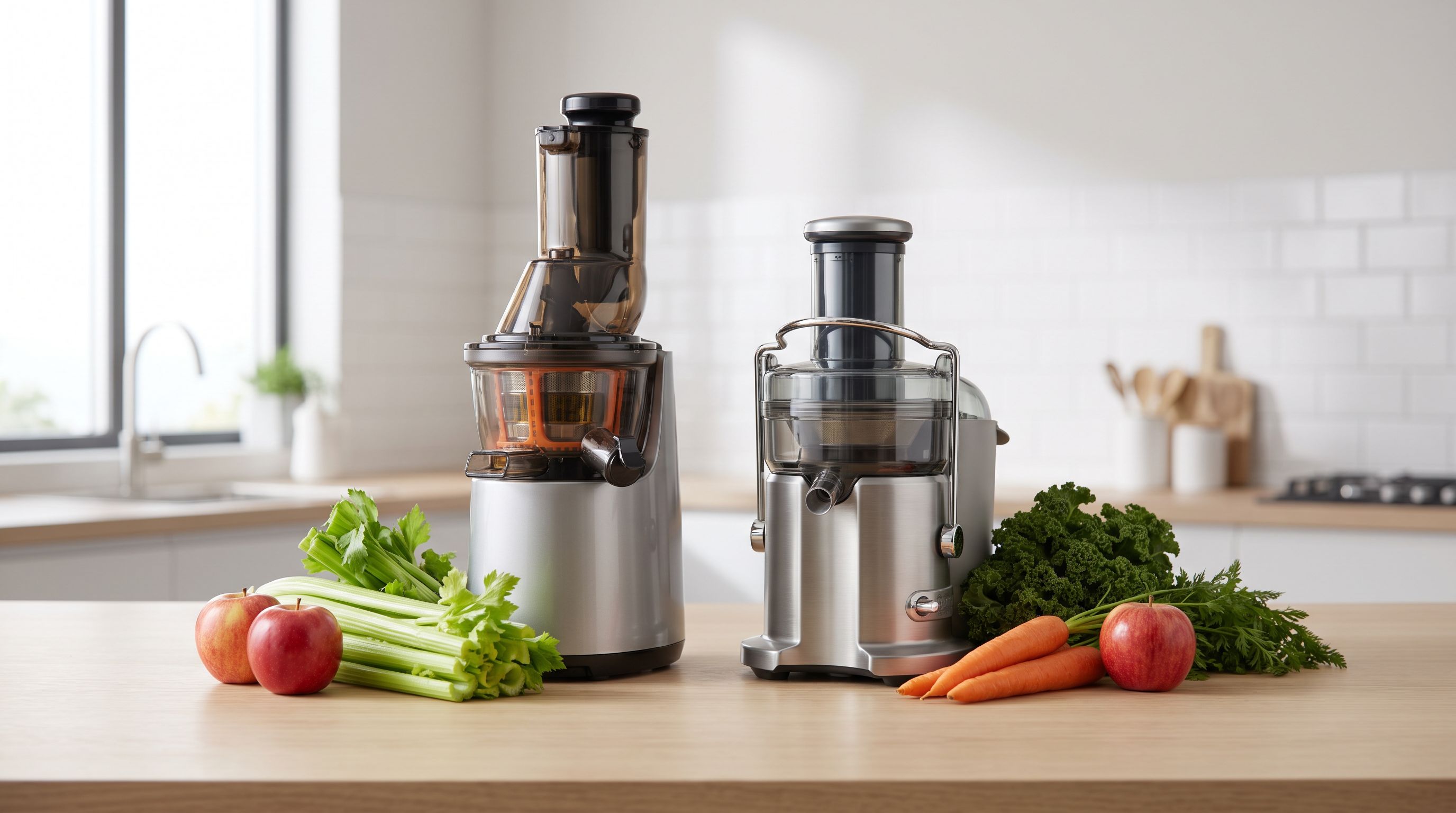
Juicer marketing is built on two numbers that barely matter: RPM and "nutrient retention." What actually decides whether a machine earns its counter space is far more boring — how much torque the motor can deliver at low speed, how wide the feed chute is, how dry the pulp comes out, and how many parts you have to scrub afterwards.
We compared current auger (masticating/cold press) and centrifugal models against manufacturer specs, independent review results, and verified owner feedback to sort out which design suits which kitchen. The short version: centrifugal machines win on speed and hard produce, augers win on greens, yield and quiet operation, and the "commercial-grade home juicer" category mostly means a heavier motor and a bigger footprint rather than anything you'd find in a juice bar.
How the two designs actually differ
A centrifugal juicer shreds produce against a flat spinning cutting disc at roughly 6,000–14,000 RPM, then flings the pulp outward through a mesh basket. It's fast, it handles whole apples, and it's loud. Because the shredding generates heat and whips air into the juice, the output separates quickly and tastes best within a few hours.
An auger juicer — masticating, slow, or cold press, all the same thing — turns a single screw at roughly 40–110 RPM, crushing produce against a screen or a strainer-free chamber. Low speed plus high torque means it grinds fibrous material instead of skating over it. Juice comes out cooler, foams less, and stores noticeably better (often 24–72 hours in a sealed jar).
Vertical augers like the Nama J2 and Hurom H70 Easy Clean use gravity to self-feed and take up less counter depth. Horizontal augers like the Omega MM900HDS feed sideways, apply a longer compression stroke, and are the format celery and wheatgrass fans overwhelmingly prefer.
 Easiest cleanup · Hurom H70 Easy Clean Slow Juicer — Check price on Amazon →
Torque beats RPM — and feed chute size beats both
Manufacturers love quoting wattage, but wattage is drawn power, not delivered force. A 150W auger juicer with good gearing will out-extract a 250W one with a weak gearbox. What to look for instead:
- Auger material and taper. Heavy, deeply tapered augers (usually Ultem/PEI or similar high-strength plastic) handle carrots and beets without stalling. Thin augers stall or trigger reverse constantly.
- A real reverse function. Non-negotiable on any auger juicer. The Ninja NeverClog JC151 leans on this heavily and it's the main reason it survives in casual-user kitchens.
- Chute diameter. Centrifugal machines like the Breville Juice Fountain Cold XL use a 3.5-inch chute that swallows whole apples — that's the entire reason they're faster, not the motor. Most auger juicers have chutes under 2 inches and require chopping. The Nama J2's hopper is the exception: you load it, close the lid, and it feeds itself.
 Best centrifugal for whole produce · Breville Juice Fountain Cold XL — Check price on Amazon →
If your juicing habit dies because of prep time rather than cleanup, chute size is the single spec that matters most.
Pulp dryness is the honest yield test
Yield claims are unverifiable at home unless you weigh output. But pulp dryness is a decent proxy, and it's where the two designs split clearly:
- Auger pulp comes out as a crumbly, barely-damp cake. Re-juicing it yields almost nothing.
- Centrifugal pulp stays visibly wet; squeeze a handful and liquid runs out. Independent testing routinely shows centrifugal machines losing meaningful yield on leafy greens in particular — kale and spinach have little free liquid and need crushing, not shredding.
For hard produce (carrots, apples, beets, citrus, ginger), the gap narrows a lot. A good centrifugal juicer is genuinely competitive on a bag of carrots, and it'll finish in a third of the time.
Compare the formats
| Vertical auger | Horizontal auger | Centrifugal | |
|---|---|---|---|
| Typical speed | ~43–80 RPM | ~80–110 RPM | ~6,000–14,000 RPM |
| Best for | Mixed produce, soft fruit, batch juicing | Celery, wheatgrass, greens, nut milk | Apples, carrots, beets, big volume |
| Feed chute | Narrow, or hopper-fed | Narrow, requires chopping | Up to ~3.5 in, whole fruit |
| Pulp dryness | Very dry | Driest | Noticeably wet |
| Noise | Low hum | Low hum | Loud |
| Juice shelf life | Good (chilled, sealed) | Good | Drink same day |
| Time for one glass | 3–6 min incl. prep | 4–7 min incl. prep | 1–3 min |
| Cleanup | 4–7 parts, screen scrubbing | 4–6 parts | Basket brush, fewer parts |
| Counter footprint | Tall, shallow | Wide, shallow | Tall and wide |
Which one should you buy?
Buy an auger if you juice greens, celery, or herbs; you want to make a batch and refrigerate it; you juice early mornings in a quiet house; or you care about squeezing the most out of expensive organic produce. The Nama J2 is the pick most reviewers land on for 2026 because the hopper removes the two worst parts of cold pressing — chopping and babysitting the plunger. The Hurom H70 Easy Clean is the one to choose if cleanup is your actual dealbreaker; its strainer-free chamber eliminates the fine mesh screen that makes most cold press owners quit.
Buy a horizontal auger if celery juice is the whole point. The Omega MM900HDS ships with a dedicated celery end cap and runs at a low enough speed to keep long fibers from wrapping the auger. It also does nut milks and frozen fruit sorbets, which vertical models handle less gracefully.
Buy a centrifugal if you juice hard produce in volume, you're feeding a family, and you'd rather spend three minutes than fifteen. The Breville Juice Fountain Cold XL's wide chute and large pulp bin mean you can run several pounds of apples and carrots without stopping to empty anything. Accept the noise and the slightly wetter pulp; that's the trade.
Buy the Ninja NeverClog JC151 if you're not yet sure you'll stick with juicing. It's compact, the parts go in the dishwasher, and the clog-reversing auger forgives bad technique. It's slower than a centrifugal and lower-yielding than a premium cold press, but it's the lowest-regret entry point.
What "commercial" really means at home
Genuine commercial juicers — the ones in juice bars — are built around duty cycles measured in hours, with metal housings, replaceable screens and a service network. Almost nothing sold for home kitchens meets that standard, regardless of the word on the box. What you can reasonably get at home is: a metal-reinforced gearbox, a long motor warranty (10–15 years on good augers, 1–5 on most centrifugals), and replacement parts you can actually order. Check parts availability before you buy. A juicer with no spare screen for sale is a disposable juicer.
Prep and cleanup habits that change everything
- Rinse parts the second you finish. Dried pulp on a mesh screen is the reason juicers end up in cupboards.
- Alternate hard and soft produce in an auger so the hard stuff pushes the soft stuff through.
- Roll leafy greens into tight cylinders before feeding.
- Chill produce first — cold produce juices cleaner and the juice keeps longer.
- For centrifugal machines, let the motor reach full speed before feeding, and feed slowly. Ramming produce down hard is the main cause of wet pulp.
FAQ
Is cold-pressed juice actually more nutritious?
It's measurably less oxidized and separates more slowly, which is why it keeps longer. Nutrient differences in practice are modest and vary by produce. Choose an auger for yield, storage and greens performance — not for miracle claims.
Can a centrifugal juicer do celery?
Poorly. The shredding disc skates along the fibers and leaves soaking-wet pulp. If celery is a regular part of your routine, a horizontal auger like the Omega MM900HDS is the right tool.
How long does fresh juice keep?
Auger-pressed juice typically holds 24–72 hours in a sealed glass jar filled to the brim and refrigerated. Centrifugal juice is best consumed the same day.
Do I need to peel citrus and ginger?
Peel citrus — the oils in the rind taste bitter and can damage some plastic parts. Ginger can go in unpeeled if it's scrubbed clean.
Is a juicer better than a high-powered blender?
They do different jobs. A blender keeps all the fiber and makes a smoothie; a juicer removes it. If you want fiber, buy a blender. If you specifically want large volumes of produce in a drinkable, fast-absorbing form, buy a juicer.
Our picks

NAMA J2 - Cold Press Juicer - Hands-Free - Black
Hands-off hopper feeding and genuinely dry pulp make it the auger juicer most reviewers rank first.
Breville BJE830BSS Juice Fountain Cold XL, Brushed Stainless Steel
A 3.5-inch chute and big motor turn a counter of apples and carrots into juice in minutes.
Omega MM900HDS Celery Juicer
Low-RPM horizontal auger with a dedicated celery end cap that keeps fibrous stalks from clogging.

Ninja NeverClog Cold Press Juicer, 24oz Jug, 36oz Pulp, Charcoal, JC151
Small footprint, dishwasher-safe parts and a clog-reversing auger for occasional juicers.
Hurom H70 Cold Press Juicer Machine, Easy to Clean Masticating Slow Juicer, Ideal Balance of Size and Function, Compact, Strainer Free, Self Feeding, Hands Free, with Wide Mouth Hopper (Black)
Strainer-free chamber design cuts the worst part of cold pressing down to a quick rinse.
Get the best kitchen gear deals in your inbox
Join the PrepDeck newsletter for hand-picked kitchen gear deals and new buying guides. No spam, unsubscribe anytime.
Related reads
Convection Microwaves in 2026: 5 Picks by Cubic Feet
The best convection microwave 2026 picks compared by interior cubic feet, turntable diameter and external footprint — so you know what actually fits your counter.
Countertop vs Over-the-Range Microwave: Fit First in 2026
Countertop vs over the range microwave in 2026: compare cavity size, venting CFM, 30-inch cutouts, clearance rules and long-term reliability before you buy.
Smokeless Indoor Grills in 2026: Watts, Plates, Real Sear
Which smokeless indoor grill actually sears? We compare wattage, plate material, and smoke control from owner feedback to find the best indoor grill for apartments in 2026.