Espresso Machine Reliability 2026: What Breaks First
Which espresso machine parts fail first — pumps, gaskets, solenoids, boilers — and which sub-$1,500 brands actually sell replacements. A 2026 reliability guide.
Reader-supported: we may earn a commission from links on this page, at no extra cost to you. It never affects our picks. Learn more.
Most home espresso machines don't die. They get abandoned — because a $9 gasket turned into a $180 service quote, or because the brand stopped selling the one plastic part that cracked.
That's the real reliability story in the sub-$1,500 category. Build quality matters, but parts availability and repairability matter more, because almost every machine in this price range uses the same handful of wear components. We compared owner feedback, dealer parts catalogs, repair-forum threads, and manufacturer service policies to map out what fails first and who actually sells you the fix.
The failure timeline: what breaks, and when
Across brands, failures cluster into a predictable order. These are patterns from owner reports and repair resources, not lab data — your water hardness and usage volume will shift the timing dramatically.
Year 1–2: group head gasket and shower screen
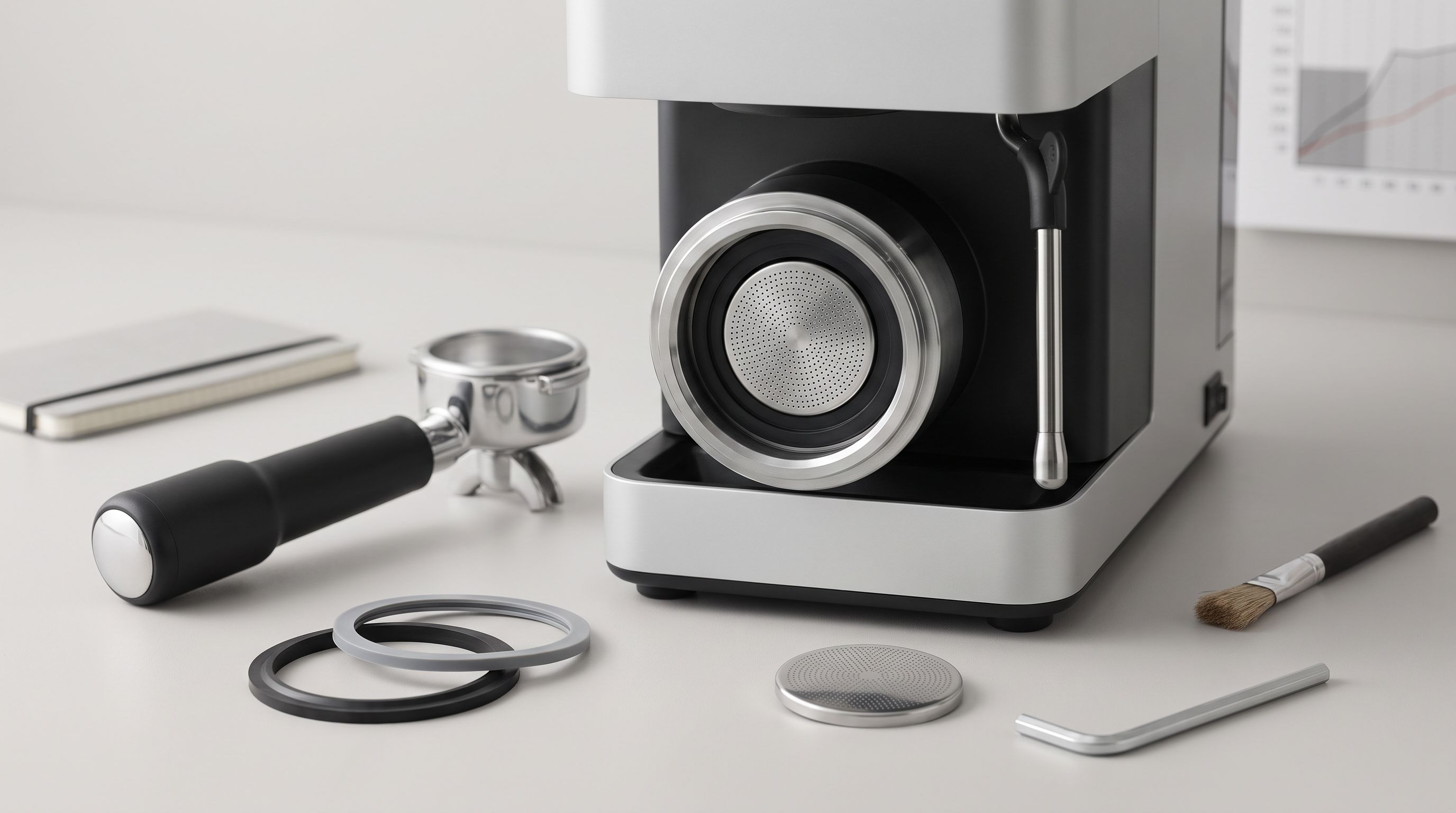
The silicone or rubber gasket that seals the portafilter hardens from heat cycling. Symptoms: the portafilter needs more and more twist to seat, then starts hissing and dripping around the edge. This is a 10-minute job with a screwdriver on most machines — and on Gaggia Classic Evo Pro and Rancilio Silvia, it's a part you can buy from a dozen vendors. On fully-sealed machines it's often a service-center visit.
 Most durable build · Rancilio Silvia — Check price on Amazon →
 Best overall for repairability · Gaggia Classic Evo Pro — Check price on Amazon →
Verdict: not a failure, a consumable. Replace yearly if you pull several shots a day.
Year 2–4: scale in the boiler or thermoblock
The single biggest killer of machines under $1,500. Scale insulates heating elements (temperature drifts, shots get sour), narrows passages (flow drops), and eventually seizes valves.
Thermoblock and thermocoil designs — the aluminium or steel channels used in most DeLonghi and many Breville models — are especially vulnerable because the passages are narrow. Breville's Thermojet heaters in the Bambino Plus heat a small water volume quickly, which reduces standing hot water but does not make them immune. Brass boilers, like the one in the Rancilio Silvia, tolerate scale better and can be descaled aggressively or even disassembled.
Verdict: preventable. Use filtered or remineralized low-hardness water and descale on schedule. This single habit is worth more than any brand choice.
Year 3–5: vibratory pump
Nearly every machine under $1,500 uses a 50/60 Hz vibratory pump — usually an Ulka EP5 or similar. They're loud by design, and when they start to fail you get weak pressure, inconsistent flow, or a louder-than-usual buzz with no water.
The good news: these pumps are a commodity. On a Gaggia Classic, swapping one is a well-documented hour of work with spade connectors and a hex key. The bad news: on sealed, compact machines the pump may be epoxied into a potted assembly, making replacement a whole-unit job.
Year 3–6: solenoid (three-way) valve
The three-way valve releases pressure from the puck after the shot — it's why a Gaggia or Rancilio leaves a dry, knockable puck while most sub-$300 machines leave soup. Over time the valve's plunger gums up with coffee oils and scale, and it sticks. Symptoms: dripping from the group after the shot stops, or no pressure release at all.
Rebuild kits exist for Gaggia and Rancilio. On machines without a solenoid, this failure simply doesn't apply — but neither does the dry puck.
Year 4–8: thermostats, OPV, and electronics
Thermostats and the over-pressure valve (OPV) drift rather than fail outright, so symptoms are subtle: shots run fast, steam gets weak, temperature wanders. On PID-equipped machines, the controller board is the expensive failure — and the one most likely to be discontinued.
Plastic water tank fittings, drip tray tabs, and steam knobs also break here. These are the parts brands most often stop stocking.
How the major sub-$1,500 brands compare on parts
| Brand / model family | Core wear parts | DIY-friendly? | Parts availability | Biggest weak point |
|---|---|---|---|---|
| Gaggia Classic Evo Pro | Gasket, solenoid, Ulka pump, aluminium boiler | Excellent — standard fasteners, huge community | Excellent; third-party and OEM, decades deep | Aluminium boiler is scale-sensitive |
| Rancilio Silvia | Gasket, solenoid, pump, brass boiler, thermostats | Excellent — serviceable like a commercial machine | Excellent via espresso specialists | Steam/brew recovery, not durability |
| Breville (Bambino Plus, Barista Express Impress) | Thermojet/thermocoil, pump, grinder burrs, seals | Limited — proprietary fasteners, sealed assemblies | Consumables yes; internals via service center | Repair economics after warranty |
| DeLonghi (La Specialista line) | Thermoblock, pump, seals, grinder parts | Limited | Patchy outside warranty channel | Scale in thermoblock |
| Profitec / ECM / Lelit (entry models) | E61 gaskets, pump, boiler, valves | Good — designed for service | Good via specialist dealers | Higher parts cost per item |
The pattern: machines built around standard commercial components stay fixable; machines built around integrated modules get replaced. That's not a knock on Breville — the Bambino Plus and Barista Express Impress are genuinely good machines that many owners run trouble-free for years — but it's a different ownership model. You're buying convenience and a warranty, not a 15-year rebuildable platform.
What to buy if longevity is your priority
Gaggia Classic Evo Pro is the repairability benchmark under $1,500. The Evo revision moved to a stainless steel brew path and a more standard group, and the parts catalog is enormous. Owners routinely report machines running past a decade with periodic gasket, solenoid and pump refreshes. It demands more of you — no PID from the factory, modest steam power — but nothing on it is a mystery.
Rancilio Silvia is the durability pick. Brass boiler, commercial-style 58 mm group head, heavy chassis. It's a one-shot-at-a-time machine with a slow steam transition, but it's the one most likely to still be working in 2040 with routine service.
Breville Bambino Plus earns its place for small kitchens. The Thermojet heater reaches temperature in seconds and holds minimal standing water, which sidesteps a lot of boiler-scale trouble. Accept that major repairs go through Breville, and budget accordingly.
 Best compact pick · Breville Bambino Plus — Check price on Amazon →
Breville Barista Express Impress is the best choice if you want grinder and machine in one box. Reliability-wise, the grinder is the thing to watch: burrs dull, and the dosing and tamping mechanism has more moving parts than a standalone machine. Burrs and hoppers are available as service parts.
 Best all-in-one · Breville Barista Express Impress — Check price on Amazon →
Profitec Go is the step up. It's sold through espresso specialists who stock service parts, uses a proper PID, and is built to be opened. If you want prosumer repairability without a dual-boiler footprint, this is the sensible end of the budget.
Five habits that outlast any brand choice
- Control your water. Target soft, low-mineral water with some buffering. Hard water destroys heating elements faster than anything else you can do.
- Descale on the manufacturer's schedule, not when symptoms appear.
- Backflush weekly if your machine has a three-way solenoid — it's what keeps the valve from sticking.
- Replace the gasket and shower screen annually. Cheap, fast, and it prevents the "my machine leaks" panic.
- Buy the parts list before you buy the machine. Search the model name plus "gasket" and "pump." If nothing comes up from independent sellers, you're buying a disposable appliance.
FAQ
How long should an espresso machine last? With filtered water and routine descaling, a serviceable semi-automatic like the Gaggia Classic Evo Pro or Rancilio Silvia commonly runs 10+ years with consumable replacements. Sealed compact machines more often see 4–8 years of trouble-free use before a repair becomes uneconomical.
Is a thermoblock less reliable than a boiler? Not inherently — but thermoblocks and thermocoils have narrower water passages, so scale causes problems sooner and is harder to clear. Brass boilers handle hard water best; aluminium boilers sit in between.
Are vibratory pumps a weak point? They're the most commonly replaced electrical part, but they're also the cheapest and most standardized. The question isn't whether the pump will fail — it's whether you can reach it.
Does a PID improve reliability? It improves temperature stability, not longevity. A PID adds a control board, which is one more thing that can fail and one more part that may be discontinued.
Is an all-in-one machine with a grinder riskier? Slightly, because there are more moving parts. On the Barista Express Impress, treat the burrs as a wear item and keep oily dark roasts out of the hopper to reduce gumming.
Our picks
Gaggia RI9380/46 E24 Espresso Machine, Brushed Stainless Steel
Decades-old parts ecosystem: gaskets, solenoids, pumps and boilers are all cheap and widely stocked.
Rancilio Silvia Espresso Machinet,0.3 liters, with Iron Frame and Stainless Steel Side Panels, 11.4 by 13.4-Inch
Brass boiler and commercial-style group head; parts stay available for 20+ year-old units.
Breville BES500BSS Bambino Plus Espresso Machine, Brushed Stainless Steel
Thermojet heater avoids scale-prone boilers, but expect service-center repairs rather than DIY.
Breville BES876BSS Barista Express Impress, Brushed Stainless Steel
Grinder and machine in one; the grinder burrs and dosing parts are the serviceable wear items.
Profitec Go
E61-adjacent build with a PID and a specialist dealer network that stocks service parts.
Get the best kitchen gear deals in your inbox
Join the PrepDeck newsletter for hand-picked kitchen gear deals and new buying guides. No spam, unsubscribe anytime.
Related reads
Convection Microwaves in 2026: 5 Picks by Cubic Feet
The best convection microwave 2026 picks compared by interior cubic feet, turntable diameter and external footprint — so you know what actually fits your counter.
Countertop vs Over-the-Range Microwave: Fit First in 2026
Countertop vs over the range microwave in 2026: compare cavity size, venting CFM, 30-inch cutouts, clearance rules and long-term reliability before you buy.
Auger vs Centrifugal: The Best Juicer 2026 Buyers Argue Over
Auger or centrifugal? We compare torque, feed chute size, pulp dryness and cleanup to help you choose the best juicer 2026 has for your produce and counter space.