Wine Fridge Buying Guide 2026: Picks by Bottle Count
A practical wine fridge buying guide for 2026: usable bottle capacity, compressor vs thermoelectric cooling, clearance rules, and picks from 18 to 166 bottles.
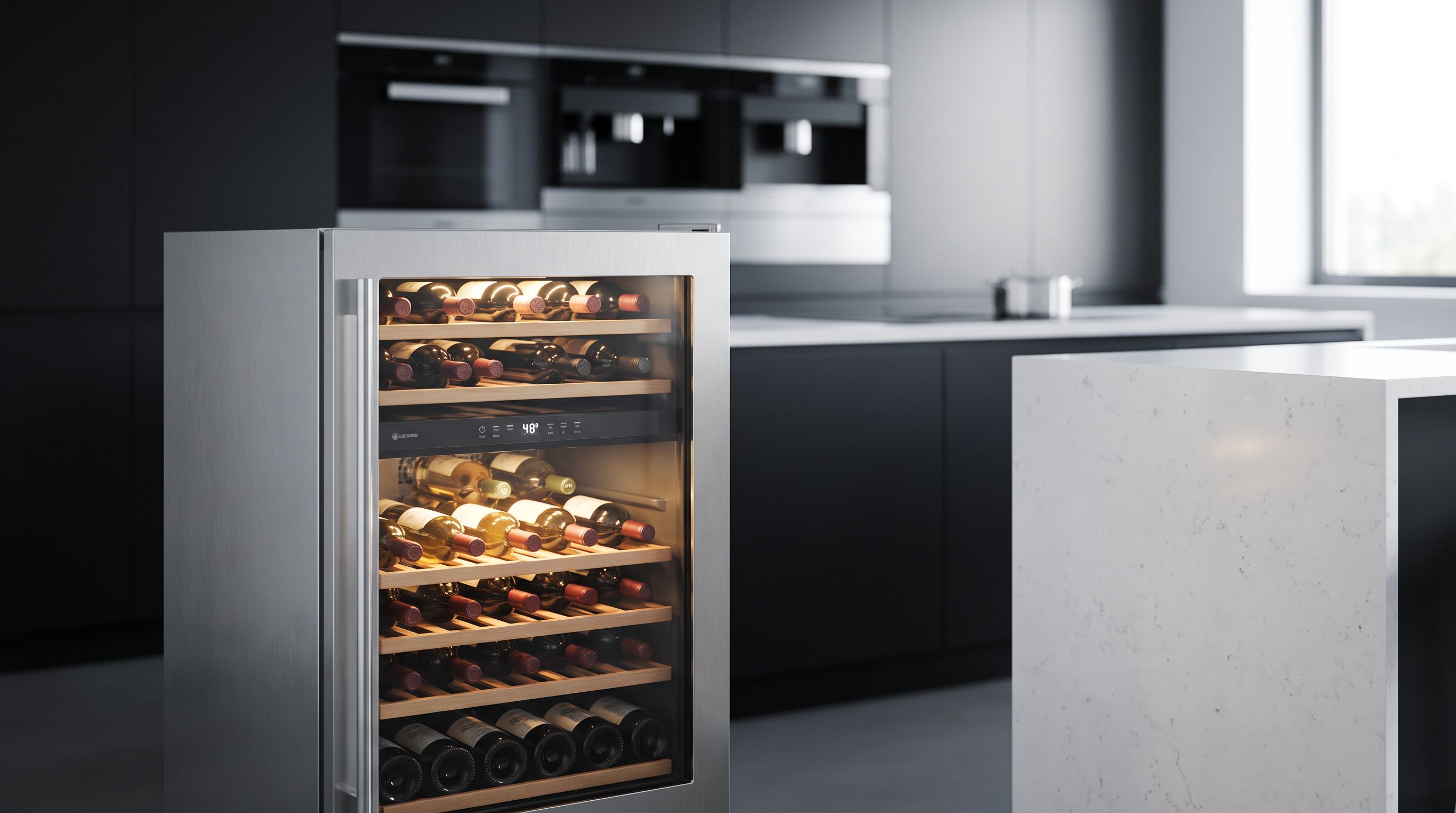
Reader-supported: we may earn a commission from links on this page, at no extra cost to you. It never affects our picks. Learn more.
Most people buy a wine fridge one size too small. You measure the gap in your cabinetry, count the bottles currently on the rack, and buy accordingly — then discover that the "28-bottle" rating assumed 28 identical Bordeaux bottles laid in perfect rows, and your Burgundies, Champagnes and Rieslings don't stack that way.
This guide ranks freestanding and undercounter wine coolers by usable capacity rather than marketing capacity, and explains the two decisions that matter most: compressor versus thermoelectric cooling, and whether your chosen unit can legally and safely sit where you want it.
Start with usable bottle count, not the number on the box
Manufacturers rate capacity using a standard 750 ml Bordeaux bottle — roughly 3 inches in diameter, 12 inches tall. Real cellars contain:
- Burgundy and Rhône bottles — wider shoulders, often 3.4 inches across. Two or three per shelf fewer.
- Champagne and sparkling — taller and heavier, frequently requiring a shelf to be removed entirely.
- Magnums — almost never fit a standard shelf without pulling one out.
A practical rule: assume you'll get 70–80% of rated capacity if you drink a mixed cellar, and close to 100% only if you buy cases of the same Cabernet. If you want 36 usable slots, shop in the 46–54 bottle class. The Reddit-style brief of "24 to 36 bottles, quiet, stable temperature" almost always resolves to a 46-bottle unit in practice.
Also look for full-extension sliding shelves on roller glides. Fixed wire racks that only pull halfway force you to lift bottles over a lip, which disturbs sediment and makes the back row effectively invisible.
Compressor vs thermoelectric: the decision that drives everything
This is the single biggest performance fork, and the cheap end of the market is dominated by thermoelectric units that quietly underperform in warm rooms.
| Compressor | Thermoelectric | |
|---|---|---|
| How it cools | Same vapour-compression cycle as a refrigerator | Peltier plate moves heat electrically |
| Typical capacity range | 18–300+ bottles | Usually under 30 bottles |
| Cooling power | Can hold set point in a 30 °C/86 °F room | Typically cools ~15–20 °F below ambient only |
| Noise | Audible cycling hum | Near-silent, but fans still run |
| Vibration | Small but present; better units isolate the compressor | Effectively none |
| Energy use at scale | More efficient on larger cabinets | Inefficient above ~30 bottles |
| Best for | Kitchens, garages, anything over 30 bottles, long-term ageing | Bedrooms, offices, small collections, cool rooms |
Choose compressor if the unit lives in a kitchen (ambient heat from ovens), a garage, a conservatory, or anywhere summer temperatures climb. Every unit over roughly 30 bottles should be compressor-cooled. The Wine Enthusiast Classic 80 Wine Cellar is the clearest example of doing this right at scale — Wirecutter has recommended the Classic 80 as its freestanding pick, and the appeal is less about features than about a compressor that holds a steady single-zone temperature across a genuinely large cabinet.
Choose thermoelectric only if silence outranks everything and the room stays cool year-round. The Ivation 18-Bottle Thermoelectric Wine Cooler is the sensible version of this: small, vibration-free, and honest about what it is. Put it in a 28 °C conservatory and it will struggle, and that's physics, not a defect.
 Quietest for living spaces · Ivation 18-Bottle Thermoelectric Wine Cooler — Check price on Amazon →
Freestanding vs built-in: the clearance rule people ignore
This matters more than any spec sheet line.
- Freestanding units vent from the back. They need air gaps — typically 2–5 inches at the rear and several inches on top. Shove one into a tight cabinet cutout and it will run constantly, fail to hit set point, and shorten compressor life.
- Built-in (undercounter) units vent from the front, through a grille in the plinth. These can sit flush in a 15-inch or 24-inch cabinet opening with zero side clearance.
If you are building out a kitchen run, you want a front-venting model. The EdgeStar CWR265SZ 26-Bottle Built-In Wine Cooler is the archetype: standard 15-inch width, front exhaust, reversible door, and a cabinet depth that lines up with typical 24-inch base cabinets. It will also work freestanding, which makes it the safer buy if your plans might change.
Measure three things before ordering: opening width (15-inch units are usually 14.9 inches wide — tight), opening height including the floor plinth, and door swing clearance against adjacent walls. Check whether the door is reversible; many are, but not all.
Single zone or dual zone?
Dual-zone coolers have two independently controlled compartments, usually around 50–65 °F up top and 40–50 °F below — reds in one, whites and sparkling in the other.
Be honest about use. If you're ageing wine, a single zone held steadily at about 55 °F is better than two zones with more door-opening disturbance. If you're serving — mixed drinking cellar, bottles rotating weekly — dual-zone is genuinely useful. The Kalamera KRC-46DZB 46-Bottle Dual Zone Wine Cooler lands exactly in the sweet spot: 46 rated bottles (roughly 34–38 real-world mixed bottles), 15-inch width, compressor cooling, and separate controls for each compartment.
 Best dual-zone · Kalamera KRC-46DZB 46-Bottle Dual Zone Wine Cooler — Check price on Amazon →
One caveat on dual zone: the two zones share a cabinet, so the maximum spread between them is limited, and the upper zone can't be set wildly warmer than the lower in some designs. Check the stated range per zone, not just the headline range.
Picks by bottle count
Under 20 bottles. The NewAir NWC018BK00 18-Bottle Wine Cooler is the pick for a narrow gap at the end of a counter or inside a bar unit. Compressor-based cooling in a small footprint beats thermoelectric here if the room gets warm. If silence matters more — a home office, a bedroom — the Ivation 18-Bottle Thermoelectric Wine Cooler is the quieter alternative.
 Best small footprint · NewAir NWC018BK00 18-Bottle Wine Cooler — Check price on Amazon →
20–30 bottles, built in. The EdgeStar CWR265SZ 26-Bottle Built-In Wine Cooler. Front venting is the whole argument; everything else is secondary.
30–50 bottles, mixed cellar. The Kalamera KRC-46DZB. This is the size most people should have bought in the first place.
50+ bottles, serious collecting. The Wine Enthusiast Classic 80 Wine Cellar. Eighty rated bottles translates to something like 60–65 real ones, which is enough to hold a drinking cellar plus a few cases put away.
Features worth paying for — and ones that aren't
Worth it:
- UV-resistant, dual- or triple-pane glass. Light degrades wine. Solid doors are even better if you don't need to see in.
- Full-extension wooden or wood-fronted shelves. Beech or similar absorbs minor vibration and slides smoothly.
- Carbon filter / humidity control. Keeps corks from drying on long-held bottles.
- Digital thermostat with memory that restores your setting after a power cut.
Skip or discount:
- Colour-changing LED lighting. Fine, but never a tiebreaker — and leave interior lights off when not browsing.
- Wi-Fi app control. On a cabinet you set once and leave alone, it adds a failure point.
- Very high rated capacities in small cabinets. A 32-bottle rating on an 18-inch cabinet means thin, closely spaced racks that fit only slim bottles.
Placement, noise and maintenance
Give compressor units a stable, level floor — an unlevel cabinet amplifies vibration into audible buzz. Avoid placing a wine fridge against a dishwasher or oven side panel. Expect a compressor unit to be audible in a quiet room; roughly fridge-level sound is normal, and owner complaints about noise usually trace back to inadequate rear clearance.
Clean the condenser area and front grille once or twice a year. If your unit has a carbon filter, replace it on the maker's schedule. And set the temperature once, then leave it — stability matters far more to wine than the exact number.
FAQ
What temperature should I set a wine fridge to? For storage and ageing, about 55 °F (13 °C) suits nearly everything. For serving, roughly 60–65 °F for reds and 45–50 °F for whites and sparkling. Stability beats precision — a cabinet that swings 6 degrees daily is worse than one sitting steadily two degrees off ideal.
Can I put a freestanding wine cooler under a counter? Only if you can preserve the manufacturer's rear and top clearances, which usually means an open-sided or recessed position rather than a sealed cabinet. For a flush cabinet opening, buy a front-venting built-in model such as the EdgeStar CWR265SZ.
Is a thermoelectric wine cooler good enough? For fewer than about 20 bottles in a room that stays below roughly 75 °F, yes — and it's quieter and vibration-free. In a hot kitchen or garage, no. Thermoelectric cooling can only pull the interior a fixed amount below ambient.
How many bottles will a 46-bottle cooler actually hold? Plan on 34–38 if you store a mix of Bordeaux, Burgundy and sparkling shapes. Removing a shelf for Champagne costs you several more slots.
Can a wine fridge store beer or soft drinks? Physically yes, but wine coolers run warmer than beverage fridges and usually can't reach the 34–38 °F many people want for beer. If you mostly want cold drinks, buy a beverage centre instead.
Do I need a dual-zone unit? Only if you regularly serve both reds and whites straight from the cabinet. For pure storage, a single zone at 55 °F is simpler and often more stable.
Our picks
Wine Enthusiast Classic 80 Wine Cellar
Compressor-cooled, single-zone 80-bottle capacity with a genuinely usable shelf layout for mixed bottle shapes.
NewAir 24" Dual Zone Beverage Refrigerator & Wine Cooler for 18 Bottles & 60 Cans | Freestanding or Built-In Under Counter Mini Fridge for Beer, Wine and Soda | Stainless Steel
Compact freestanding 18-bottle cooler that slots into a narrow gap without built-in installation.
Kalamera 24 Inch Wine Cooler Refrigerator, 46-Bottle Dual Zone Wine Fridge | Built-In/Freestanding Beverage and Wine Refrigerator, 5 Wooden Shelves, Reversible Glass Door, Temperature Memory
15-inch-wide compressor dual-zone unit for keeping reds and whites at separate serving temperatures.
EdgeStar CWR265SZ 26-Bottle Built-In Wine Cooler
Front-venting 15-inch built-in design that can sit flush under a standard counter run.
Ivation 18 Bottle Compressor Wine Cooler Refrigerator with Wi-Fi Smart App Control Cooling System | Large Freestanding Wine Cellar Fridge For Red White Champagne or Sparkling, Black Glass Door & Lock
Vibration-free thermoelectric cooling for bedrooms and offices where compressor hum would annoy.
Get the best kitchen gear deals in your inbox
Join the PrepDeck newsletter for hand-picked kitchen gear deals and new buying guides. No spam, unsubscribe anytime.
Related reads
Home Freeze Dryer Buying Guide 2026: Do the Tray Math
A 2026 home freeze dryer buying guide ranked by tray capacity, pump type and electrical draw — plus what batch size actually fits your pantry goals.
Fermentation Chamber Fridge 2026: Picks by Shelf Height
How to choose a fermentation chamber fridge in 2026: usable shelf height, low-temp floor, and controller compatibility for dough retarding, charcuterie, and brewing.
Air Fryer Toaster Ovens in 2026: 5 Picks by Interior Size
The best air fryer toaster oven 2026 picks ranked by usable interior: what actually fits a 12-inch pizza, a half sheet pan, or a 4-lb chicken.