Home Freeze Dryer Buying Guide 2026: Do the Tray Math
A 2026 home freeze dryer buying guide ranked by tray capacity, pump type and electrical draw — plus what batch size actually fits your pantry goals.
Reader-supported: we may earn a commission from links on this page, at no extra cost to you. It never affects our picks. Learn more.
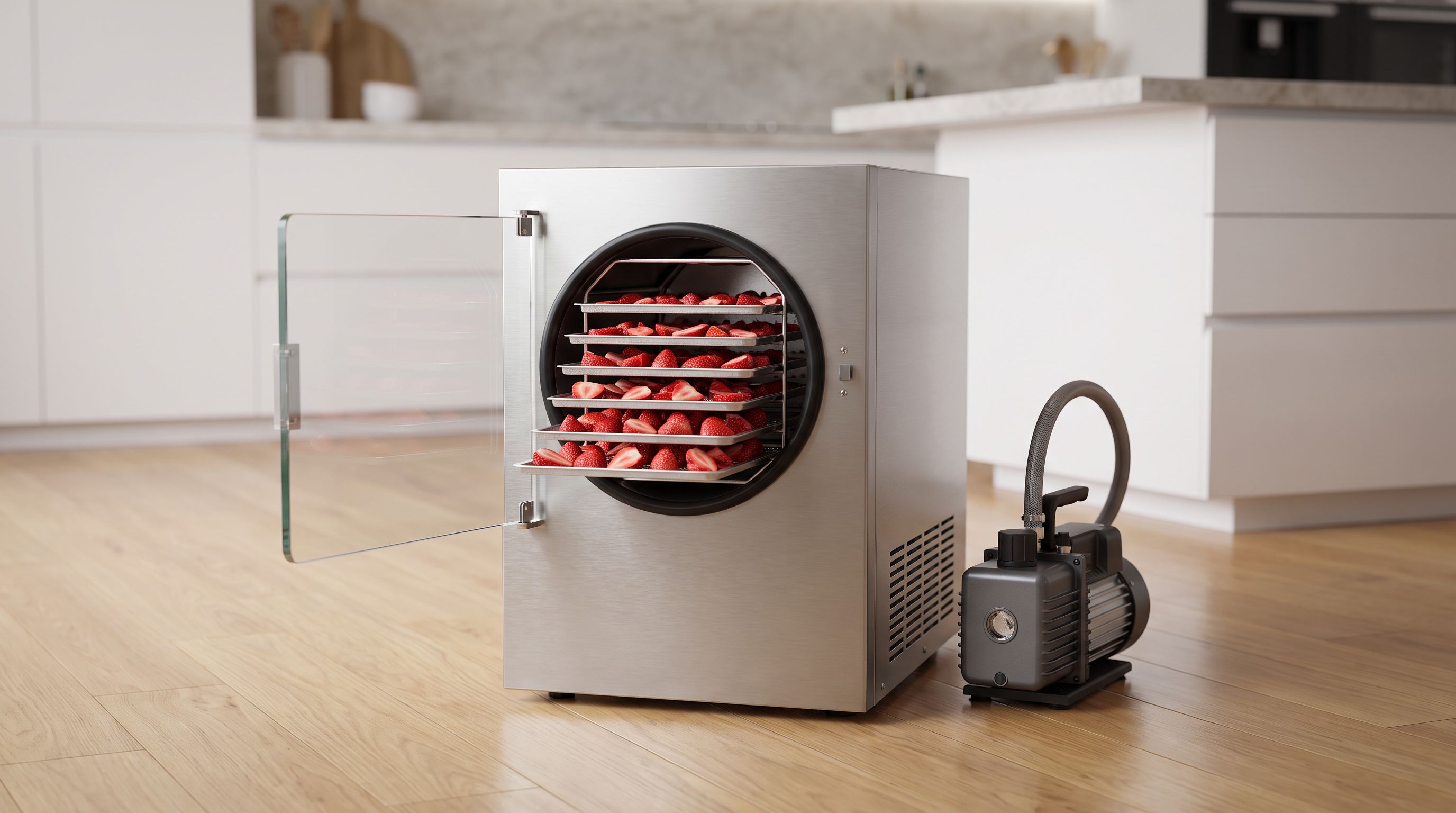
A home freeze dryer is the most expensive appliance most kitchens will ever host, and the one people research longest before buying. That's rational. It costs more than a good range, runs for 20–40 hours per batch, draws serious current, and needs a vacuum pump that either gets oil changes or doesn't. Get the size wrong and you'll either run it constantly to keep up or watch a four-figure machine sit idle.
This guide ranks home freeze dryers the way buyers should shop them: by tray capacity per batch, then pump type, then electrical draw and footprint. PrepDeck compares manufacturer specifications, independent reviews and verified owner feedback — we don't run units in a lab.
Do the tray math first
Marketing copy talks in pounds per batch. Pounds are a moving target because water content varies wildly: strawberries are mostly water, cooked ground beef is not. The number that doesn't lie is tray area and tray depth.
Here's the honest arithmetic:
- A batch cycle takes roughly 20 to 40+ hours depending on load, moisture content and pre-freezing.
- That means a realistic ceiling of 4 to 7 batches per week if you're aggressive, 2–3 if you have a life.
- Multiply your per-batch yield by that and you get your annual pantry output.
So: if you want to freeze dry a full garden harvest or a quarter beef, a small machine will physically never catch up during the weeks when food is ready. Conversely, if you're preserving leftovers, herbs, eggs and the occasional fruit flat, a large unit means half-empty trays and wasted cycle time — the machine pulls nearly the same power whether it's full or not.
Rule of thumb: size for your peak week, not your average one. Then subtract one size if you're buying mostly on enthusiasm.
Pre-freezing changes your throughput more than tray count
Loading room-temperature food means the machine spends hours just freezing it. Pre-freezing trays in a deep freezer overnight can cut several hours off a cycle and is the single cheapest throughput upgrade available. Budget freezer space accordingly — it effectively doubles the value of a mid-size unit.
Pump type: oil, oil-free, or premier
The vacuum pump is the component that will annoy you. Three broad options:
Standard oil pump. Cheapest to buy, genuinely reliable, and rebuildable. The cost is maintenance: you filter and change oil regularly, and the pump is loud enough that most owners put the whole setup in a garage, basement or utility room. If you don't mind the ritual, this is the lowest-risk choice.
Oil-free pump. No oil changes, less mess, usually quieter at the same noise class. The trade-off is that diaphragm/scroll-type pumps generally cost more upfront and the internal diaphragms are a wear item on their own schedule. Oil-free is the right call if the machine lives anywhere near living space.
Premier / integrated pumps. Newer Harvest Right configurations integrate the pump into the cabinet for a tidier footprint and lower noise. Nice if the unit has to coexist with humans; it also means you can't swap pumps as easily down the line.
There's no universally correct answer. Noise tolerance and where the machine physically lives should decide it.
Electrical draw and where it actually plugs in
This is the step buyers skip and regret. Freeze dryers combine a refrigeration compressor, heaters in the trays, and a vacuum pump — all running simultaneously.
- Small and medium units are designed for standard North American 110/120V outlets, but they want a dedicated circuit. Sharing with a space heater, microwave or freezer is how you trip breakers at hour 19 of a 30-hour cycle.
- Larger and XL units often need more headroom — in some configurations a 220V circuit — and always a dedicated run.
- Add the vacuum pump's draw if it's a separate unit on its own cord.
Before you buy, check the breaker panel and measure the floor space including clearance behind and above for heat rejection. These machines are heavy — a medium unit in the hundred-pound range is a two-person move, and the Large is worse. They are not countertop appliances.
How the main options compare
| Model | Trays (typical) | Best for | Pump options | Power notes |
|---|---|---|---|---|
| Harvest Right Home Pro Small | 3 smaller trays | Apartments, couples, trial runs | Oil or oil-free | Standard 110V household circuit |
| Harvest Right Home Pro Medium | 4 trays | Most families; the default pick | Oil, oil-free or premier | 110V, dedicated circuit strongly advised |
| Harvest Right Home Pro Large | 5 trays, deeper chamber | Homesteads, garden/livestock volume | Oil, oil-free or premier | Higher draw; verify circuit before ordering |
| Blue Alpine Freeze Dryer | Mid-size tray set | Buyers wanting an alternative brand | Oil-free pump included | 110V household configuration |
| Stay Fresh 7-Tray Dehydrator | 7 dehydrator trays | Jerky, herbs, fruit — not freeze drying | N/A (no vacuum) | Plugs into any outlet |
 Best alternative to Harvest Right · Blue Alpine Freeze Dryer — Check price on Amazon →
Tray counts and configurations change by model year and option package — confirm current specs with the manufacturer before ordering, since these are made-to-order appliances with lead times.
The picks
Harvest Right Home Pro Medium Freeze Dryer — best overall. Four trays is the capacity most households converge on after a year of use. It handles a flat of strawberries, a batch of cooked meals, or a dozen-plus eggs' worth of scramble in one go, finishes in a reasonable cycle, and runs on a standard household circuit. Across review roundups and owner forums it's the most consistently recommended size, and the one with the deepest accessory and community-knowledge ecosystem. Choose the oil-free or premier pump if it lives near people.
 Best overall · Harvest Right Home Pro Medium Freeze Dryer — Check price on Amazon →
Harvest Right Home Pro Small Freeze Dryer — best for small kitchens. Three smaller trays, the lightest unit, the shortest cycles and the easiest electrical story. If you're freeze drying herbs, leftovers, candy and the occasional fruit batch — or you simply don't have the floor space — this is the realistic choice. It's also the least painful way to find out whether you actually enjoy the hobby.
Harvest Right Home Pro Large Freeze Dryer — best for homesteaders. Five trays and a deeper chamber. If you have a garden that produces in waves, buy beef in quarters, or intend to build a multi-year pantry, the Large is the size that keeps up during harvest weeks. Verify your circuit capacity and plan a permanent home for it — basement, garage or pantry room, not the kitchen.
 Best for homesteaders · Harvest Right Home Pro Large Freeze Dryer — Check price on Amazon →
Blue Alpine Freeze Dryer — best alternative to Harvest Right. Owner reports highlight stainless tray construction and an included oil-free pump as the draws. Worth a quote if lead times, warranty terms or service responsiveness are deciding factors for you. Compare tray dimensions directly rather than trusting pound-per-batch claims.
Stay Fresh 7-Tray Food Dehydrator — budget alternative. Say this plainly: if what you actually want is jerky, dried herbs, fruit leather and apple chips, a freeze dryer is the wrong tool and about twenty times the price. A dehydrator does those jobs well. Freeze drying earns its cost only when you need shelf-stable, rehydratable, texture-preserving storage — meals, dairy, eggs, raw pet food, long-term pantry stock.
Who shouldn't buy one
- You want crispy snacks and jerky. Buy a dehydrator.
- You have no garage, basement or utility room. The noise and heat are real.
- You preserve less than a few pounds of food per month. Idle machines don't amortize.
- You can't dedicate a circuit. Fix the electrical first, or the machine will cost you a failed batch.
FAQ
How long does a batch take? Typically 20 to 40+ hours, longer for high-moisture or thickly loaded trays. Pre-freezing food solid before loading shortens the cycle meaningfully.
Does oil-free mean maintenance-free? No. You skip oil changes, but diaphragms and seals are still wear items, and the chamber, gaskets and drain line all need routine cleaning.
How long does freeze-dried food actually last? Properly dried to the correct residual moisture, sealed in Mylar with oxygen absorbers and stored cool and dark, most foods are rated for many years. Sloppy drying or poor sealing is what shortens shelf life, not the method.
Can I put one in a kitchen? Small and medium units can live in a kitchen if you have the floor space, clearance and a dedicated outlet — but the compressor and pump noise over a 30-hour run convinces most owners to relocate them.
Do I need a separate freezer too? Not required, but strongly recommended. Pre-freezing trays improves throughput and consistency more than almost any other change you can make.
Our picks
Metal Trays for Harvest Right Freeze Dryer Medium, Freeze dryer trays medium for Harvest Right home pro freeze dryer (Medium-5pcs)
Four-tray sweet spot: enough batch volume for a family pantry without a dedicated room or 220V circuit.
Metal Trays for Harvest Right Freeze Dryer Medium, Freeze dryer trays medium for Harvest Right home pro freeze dryer (Medium-5pcs)
Three smaller trays, the lightest footprint and lowest draw — the only model most apartments can host.
6 Sets Large Metal Trays With Lids Compatible for Harvest Right Freeze Dryer Large Tray – Stackable Freeze Dryer Trays with Covers, Large Freeze Dryer Accessories, Pre-Freezing & Dust Protection
Five trays and a deeper chamber for garden-harvest volume; plan on a dedicated circuit and a floor, not a counter.
Blue Alpine Medium Select Freeze Dryer – Home Freeze-Drying Machine for Food Preservation & Long-Term Storage
Stainless trays and an included oil-free pump; a credible challenger if lead times or service matter to you.
Stay Fresh 7-Tray Food Dehydrator
Not a freeze dryer — but if your goal is jerky, herbs and fruit leather, it does that job for a fraction of the money.
Get the best kitchen gear deals in your inbox
Join the PrepDeck newsletter for hand-picked kitchen gear deals and new buying guides. No spam, unsubscribe anytime.
Related reads
Wine Fridge Buying Guide 2026: Picks by Bottle Count
A practical wine fridge buying guide for 2026: usable bottle capacity, compressor vs thermoelectric cooling, clearance rules, and picks from 18 to 166 bottles.
Air Fryer Toaster Ovens in 2026: 5 Picks by Interior Size
The best air fryer toaster oven 2026 picks ranked by usable interior: what actually fits a 12-inch pizza, a half sheet pan, or a 4-lb chicken.
Electric Pressure Cookers in 2026: Pick by Quart Size First
The best electric pressure cooker 2026 guide that sorts multi-cookers by 3, 6, 8 and 10-quart capacity, inner pot material and pressure rating — match your household.