Santoku vs Nakiri in 2026: Which One Earns Board Space?
Santoku vs nakiri in 2026: how blade geometry, edge angle and knuckle clearance decide which Japanese knife belongs on your board — and which you can skip.
Reader-supported: we may earn a commission from links on this page, at no extra cost to you. It never affects our picks. Learn more.
Most people shopping for a Japanese vegetable knife end up buying both a santoku and a nakiri, then use one of them twice a year. That's a waste of drawer space. These two knives look similar in photos — flat-ish profile, tall blade, no bolster — but they're built around different cutting motions, and the one that fits your board depends on how you actually chop.
Here's the short version: a santoku is a general-purpose knife that happens to be good with vegetables. A nakiri is a vegetable knife that happens to tolerate other jobs. Pick based on what's already in your block.
The geometry, plainly
Profile and the rock-chop question
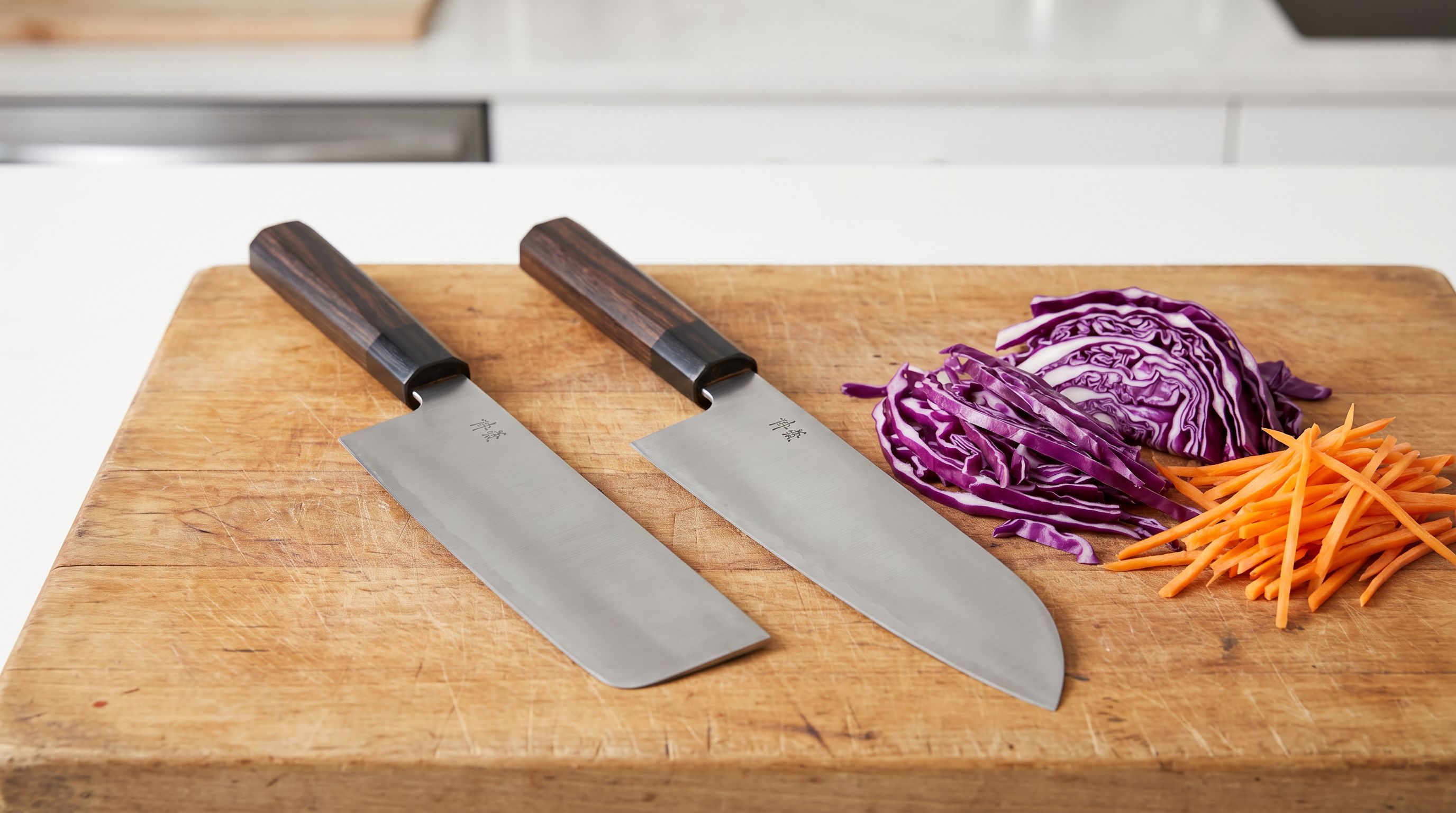
A santoku has a gently curved belly that flattens out toward the heel, finishing in a rounded "sheep's foot" tip. That slight curve lets you do a shallow rocking motion, and the sloped tip lets you break down a chicken thigh or score a fish fillet without the blade fighting you. Typical lengths run 165–180mm (about 6.5–7 inches).
A nakiri is flat. Properly flat — the edge contacts the board along its whole length at once. That makes it excellent at push cuts and pull cuts, the two motions that actually dominate vegetable prep in Japanese kitchens, and terrible at rocking. If you rock a nakiri you'll just bruise the tip against the board. The squared-off ends mean there's no usable point at all, so detail work like hulling strawberries or deveining shrimp is awkward.
So the first filter is honest self-assessment: do you rock-chop or push-cut? If you learned to cook from Western chefs and you pivot the knife off its tip, a nakiri will feel broken. If you lift the blade and push forward through an onion, a nakiri will feel like an upgrade.
Blade height and knuckle clearance
Nakiri blades usually run 50–60mm tall at the heel; santoku are closer to 40–50mm. That extra height is doing two things. First, it keeps your knuckles off the board on a long flat cut — with a short santoku you'll occasionally graze the board when you choke up on the handle. Second, it gives you a broad face to scoop a pile of diced shallot into the pan, which is more useful day to day than it sounds.
The catch: tall blades need somewhere to go. If your cutting board is small or your counter is cluttered, a 180mm nakiri with a 57mm heel is a lot of steel to maneuver. A 165mm santoku is the more forgiving object in a cramped kitchen.
Edge angle and grind
Both knives are typically ground thinner and at a steeper angle than a German chef's knife. Japanese-made examples usually land somewhere around 15 degrees per side versus roughly 20 for European knives, though manufacturers vary and some are asymmetrically ground. Western brands making "santoku-style" knives often use softer steel at a more obtuse angle, which is more durable but doesn't glide the same way.
What matters more than the number is how thin the blade is behind the edge. That's what determines whether a sweet potato splits cleanly or wedges and cracks. Nakiri are generally thinner and flatter-ground because they never need to pry or bone anything. The Tojiro DP Nakiri 165mm is a good reference point here — a VG10 core clad in softer stainless, ground thin, sharpened acutely, and priced where it doesn't hurt to actually use it.
Steel and maintenance
Harder Japanese steels (VG10, VG-MAX, SG2, Mac's proprietary blend) hold an edge longer and take a finer edge, but they chip if you twist them through a squash or hit a bone. Softer stainless (Victorinox, most German brands) rolls instead of chipping and comes back with a few passes on a steel.
If you've never used a whetstone, that's not a dealbreaker — but go in knowing that a hard Japanese edge is a stone-and-strop proposition, not a pull-through-sharpener one.
Side by side
| Santoku | Nakiri | |
|---|---|---|
| Profile | Slight belly, sheep's-foot tip | Dead flat, squared ends |
| Typical length | 165–180mm | 165–180mm |
| Blade height | ~40–50mm | ~50–60mm |
| Best motion | Push cut + shallow rock | Push cut, pull cut, tap chop |
| Knuckle clearance | Adequate | Generous |
| Proteins | Yes — boneless meat, fish | Possible but clumsy |
| Fine tip work | Limited | None |
| Buy it if | It's your only knife | You already own an all-rounder |
So which one should you buy?
Buy a santoku if it's going to be your main knife. One knife has to handle chicken breast, a side of salmon, a pile of carrots and a block of cheese. The santoku does all of that competently. The Mac Knife Professional Hollow Edge Santoku MTH-80 is the one most often recommended by independent test kitchens, and the reasons are easy to verify on spec: it's noticeably thinner than most Western santoku, the steel is hard enough to hold a long edge, and the hollow-ground dimples genuinely reduce sticking on potato and cucumber. At 8 inches it's on the long side for a santoku, which is a feature if you've been using a chef's knife.
If you want the same idea with more refinement, the Misono UX10 Santoku 180mm is a step up in fit, finish and grind geometry — a good call if you break down protein regularly and want a knife that handles fish as gracefully as it handles fennel.
 Premium santoku · Misono UX10 Santoku 180mm — Check price on Amazon →
Buy a nakiri if you already own a chef's knife or santoku you like. This is the honest use case. A nakiri is a second knife that makes a specific, high-volume job much faster: cabbage, onions, herbs, root vegetables, anything you're slicing in quantity. Independent comparisons consistently land on the same conclusion — the nakiri is faster and cleaner than a santoku on vegetables specifically, because the flat edge means no accordion slices and no half-connected onion dice. The Tojiro DP Nakiri 165mm is the value benchmark; the Shun Classic Nakiri 6.5 in is the one to get if you want a taller, stiffer blade with better finishing and a comfortable D-shaped handle.
Buy the Victorinox Swiss Classic Santoku 6.7 in if you're not sure yet. It's soft stainless, it's easy to sharpen, it survives abuse, and it costs little enough that discovering you prefer a different shape isn't an expensive mistake. Plenty of professional kitchens run Victorinox for exactly that reason.
 Budget pick · Victorinox Swiss Classic Santoku 6.7 in — Check price on Amazon →
What about buying both?
There's a legitimate version of this: a santoku or gyuto as the workhorse, plus a nakiri for vegetable-heavy prep days. That's a real two-knife system used by a lot of home cooks who eat mostly plants.
What's not legitimate is buying both as your first two Japanese knives. The overlap is large, and the money is better spent on one good knife plus a 1000/3000-grit whetstone and a decent end-grain or soft-plastic board. A dull $200 knife on a glass board is worse than a sharp $45 knife on wood, every single time.
FAQ
Is a nakiri better than a chef's knife? Better at vegetables, worse at everything else. It can't rock-chop, has no tip, and shouldn't go near bones. Treat it as a specialist, not a replacement.
Can I use a santoku for meat? Yes, for boneless cuts and fish. The sheep's-foot tip and thin grind handle slicing and portioning well. Don't use it on joints or bone-in cuts — thin Japanese edges chip.
What size should I buy? 165mm (6.5 in) suits smaller hands and smaller boards. 180mm (7 in) gives more knuckle clearance and covers bigger vegetables. For a nakiri, go taller rather than longer if you're choosing between the two.
Do these need a special sharpener? Harder Japanese steels do best on whetstones. Pull-through sharpeners with carbide wheels remove far too much metal and can chip hard edges. A honing rod helps on softer stainless like the Victorinox, less so on VG10.
Is the hollow edge (granton dimples) real or marketing? Partly real. The dimples reduce suction on starchy, wet foods like potato and zucchini. They don't eliminate sticking, and a very thin blade matters more — but on the Mac MTH-80 the combination works.
Which one for a beginner? Santoku. It teaches good push-cut technique while still doing everything else, and it won't strand you when you need a tip.
Our picks

Mac Knife Professional series 8" Chef's knife w/dimples MTH-80
Thin, hard, laser-sharp blade with granton dimples — the all-rounder most home cooks should buy first.
Tojiro DP Nakiri 165mm
VG10 core, flat 165mm edge and real knuckle clearance — the benchmark vegetable knife for the money.
Victorinox Swiss Classic 7 Inch Santoku knife, Granton Blade, Black
Soft-stainless, dishwasher-surviving santoku that sharpens in seconds and costs very little to replace.
Shun Classic Nakiri 6.5 in (DM0728)
VG-MAX core with 68-layer Damascus cladding and a notably tall, stiff blade for clean push cuts.
Misono UX10 Santoku 7.0" (18cm) - Right
Swedish stainless, thin grind and excellent fit-and-finish for cooks who slice protein as often as produce.
Get the best kitchen gear deals in your inbox
Join the PrepDeck newsletter for hand-picked kitchen gear deals and new buying guides. No spam, unsubscribe anytime.
Related reads
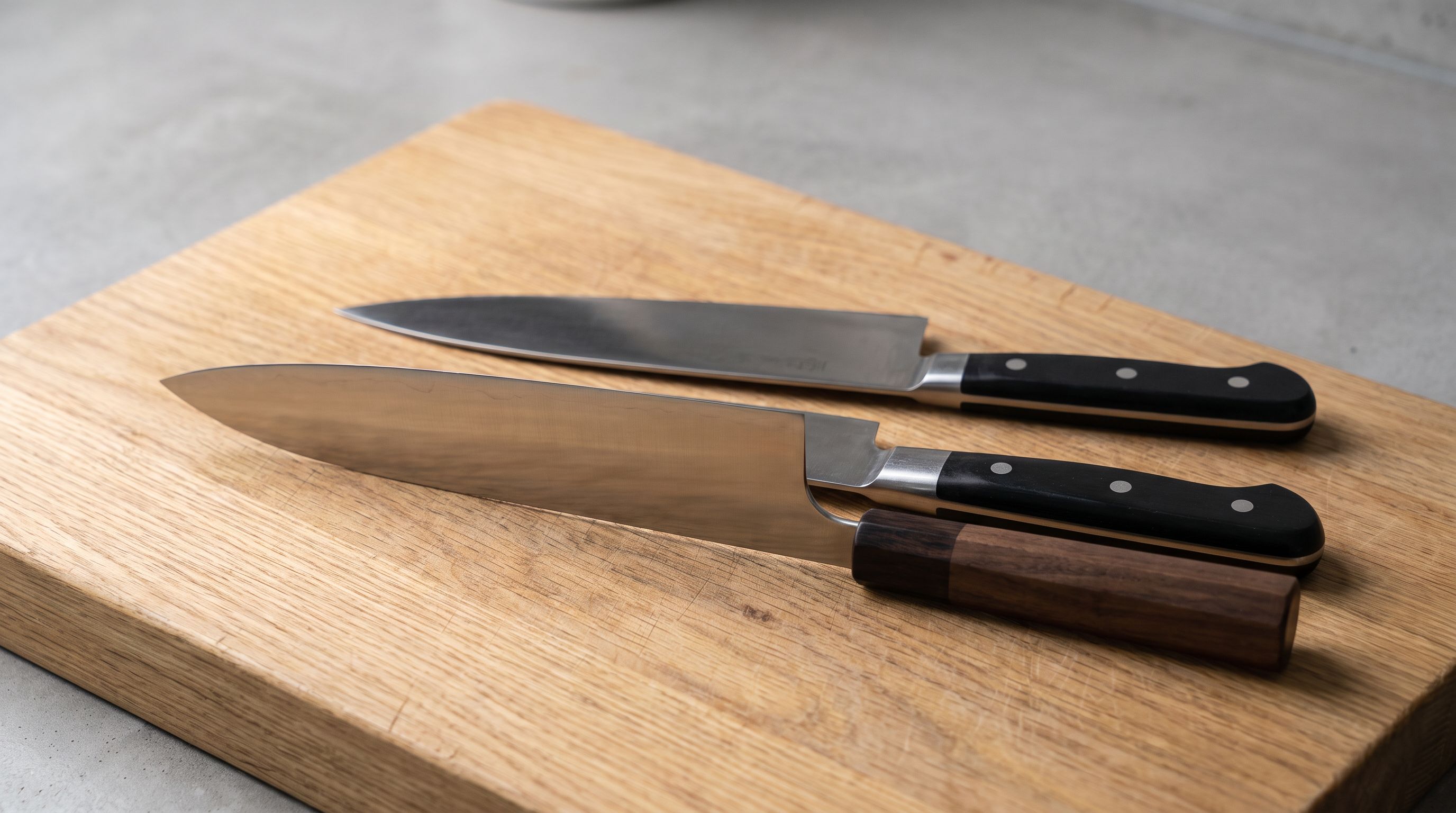
Japanese vs German Chef Knife: Which Fits Your Hands in 2026
Japanese vs German chef knife, compared on edge angle, steel hardness, blade geometry and upkeep — plus four knives worth buying as your first serious blade in 2026.
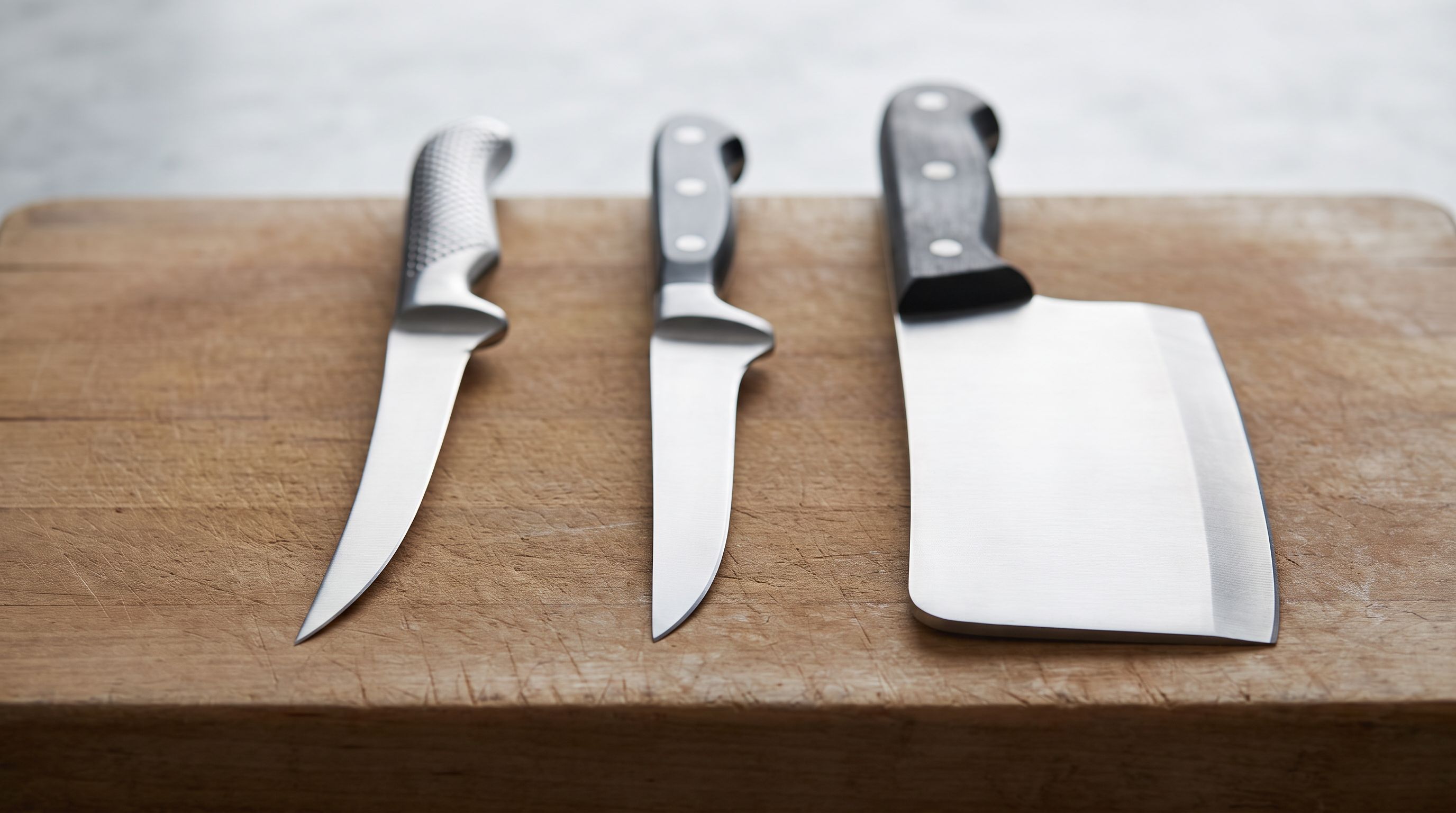
Boning Knife vs Fillet Knife (vs Cleaver): Pick One for 2026
Boning knife vs fillet knife vs cleaver: how blade flex, spine thickness and steel decide which specialty blade earns your next knife slot in 2026.
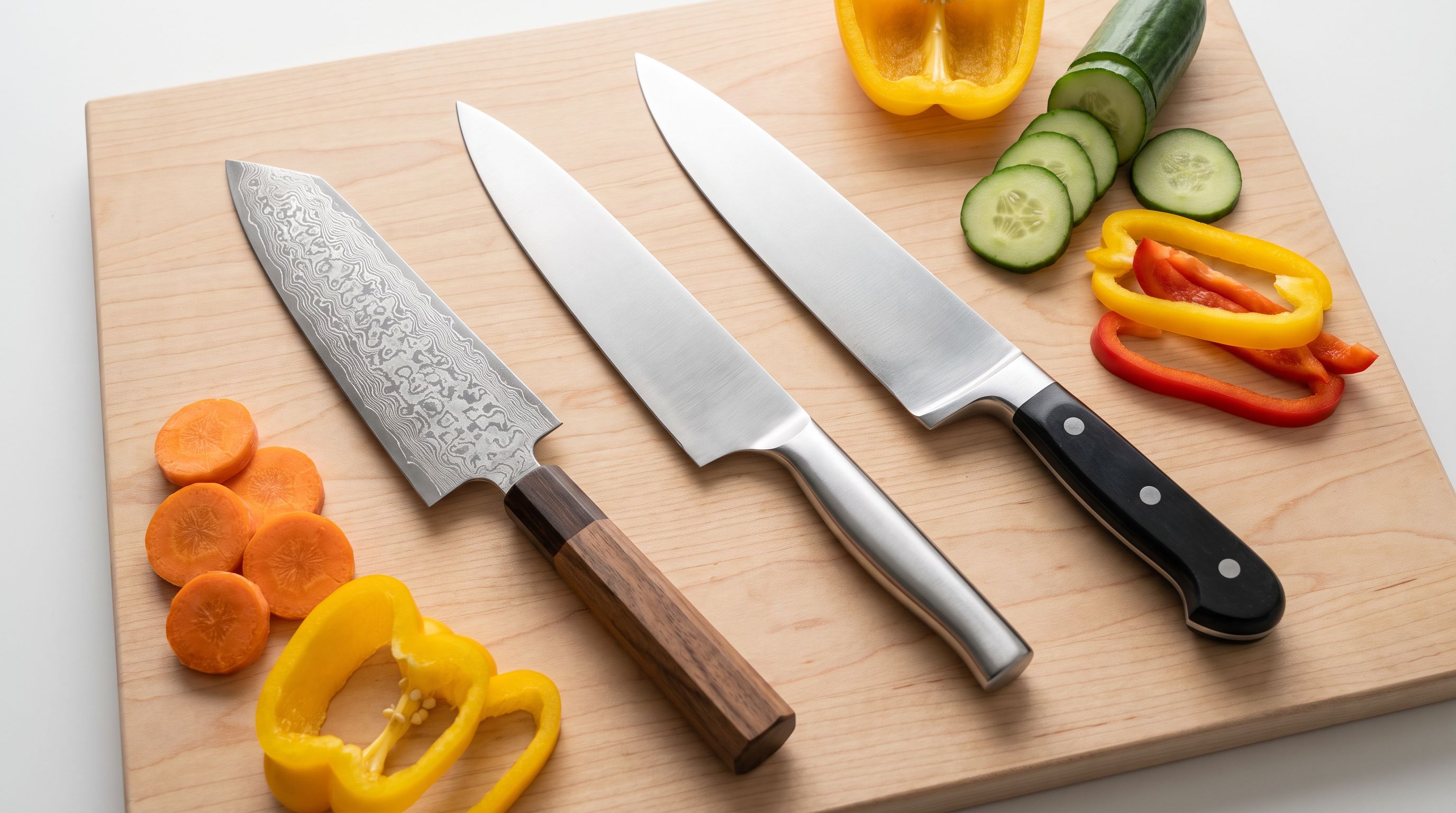
VG-10 vs AUS-10 vs S35VN: The Best Chef Knife Steel in 2026
VG-10, AUS-10, S35VN and X50CrMoV15 decoded. Learn which chef knife steel matches your cooking style, hardness, edge retention and chip risk in 2026.