Plumbed In Espresso Machine 2026: What Your Sink Needs
Thinking of plumbing in your espresso machine in 2026? Here's the line pressure, regulator, filtration and machine compatibility you actually need under the counter.
Reader-supported: we may earn a commission from links on this page, at no extra cost to you. It never affects our picks. Learn more.
Plumbing in an espresso machine is the single biggest quality-of-life upgrade a serious home barista can make — and also the one most likely to end in a damp cabinet and a warranty argument. The appeal is obvious: no refilling a two-litre reservoir mid-session, no mineral scale from whatever jug water you topped off with, and on a rotary-pump machine, a quieter, steadier shot.
The catch is that your espresso machine is now a permanently connected appliance sitting on top of a wood cabinet. Everything below matters: what pressure your house delivers, what sits between the stop valve and the machine, and whether your machine was ever designed to accept a line in the first place.
We compared current plumb-in-capable machines and the supporting hardware using manufacturer installation manuals, independent water-treatment guidance, and verified owner feedback from long-term installs.
Does your machine actually accept a direct connect?
This is step one, and it eliminates most kitchens. A machine is plumbable only if the manufacturer built a water inlet into it. You cannot convert a Breville Bambino Plus, a Gaggia Classic Pro, or a Barista Express. Their pumps draw from the tank and that's the end of the story.
Broadly, three groups can be plumbed:
- Rotary-pump prosumer machines. The standard case. A rotary vane pump is designed to accept pressurised inlet water and is far happier on a line than a vibratory pump. The ECM Synchronika and Profitec Pro 700 both ship with the inlet fitting and a tank/line selector, so you can switch back to the reservoir for travel, servicing, or if you move house.
- Vibratory-pump machines with an optional kit. Some E61 machines, including the Rocket Espresso Appartamento, offer a factory plumb-in kit. These work, but a vibe pump cannot regulate incoming line pressure — the water arrives at whatever your house gives it, and the pump only adds on top. Pressure regulation upstream becomes mandatory, not optional.
- Built-in and super-automatic units. Several built-in coffee systems (Miele, Fisher & Paykel, Smeg) offer plumbed variants, and a handful of super-automatics do too. These are cabinetry decisions more than espresso decisions — make them when you're renovating, not after.
 Best compact heat exchanger · Rocket Espresso Appartamento — Check price on Amazon →
If your machine isn't on that list, stop here. An aftermarket "conversion" that bypasses the tank on a machine not designed for it will void the warranty and can push water past seals that were never rated for standing pressure.
Line pressure: the number that decides everything
Most espresso machine manuals specify an inlet pressure range, commonly somewhere in the 1–4 bar (roughly 15–60 psi) neighbourhood, with the machine's own pump taking it from there to brew pressure. Typical North American municipal supply runs 40–80 psi, and plenty of houses sit well above that — pressures over 80 psi are common on lower floors and in newer developments.
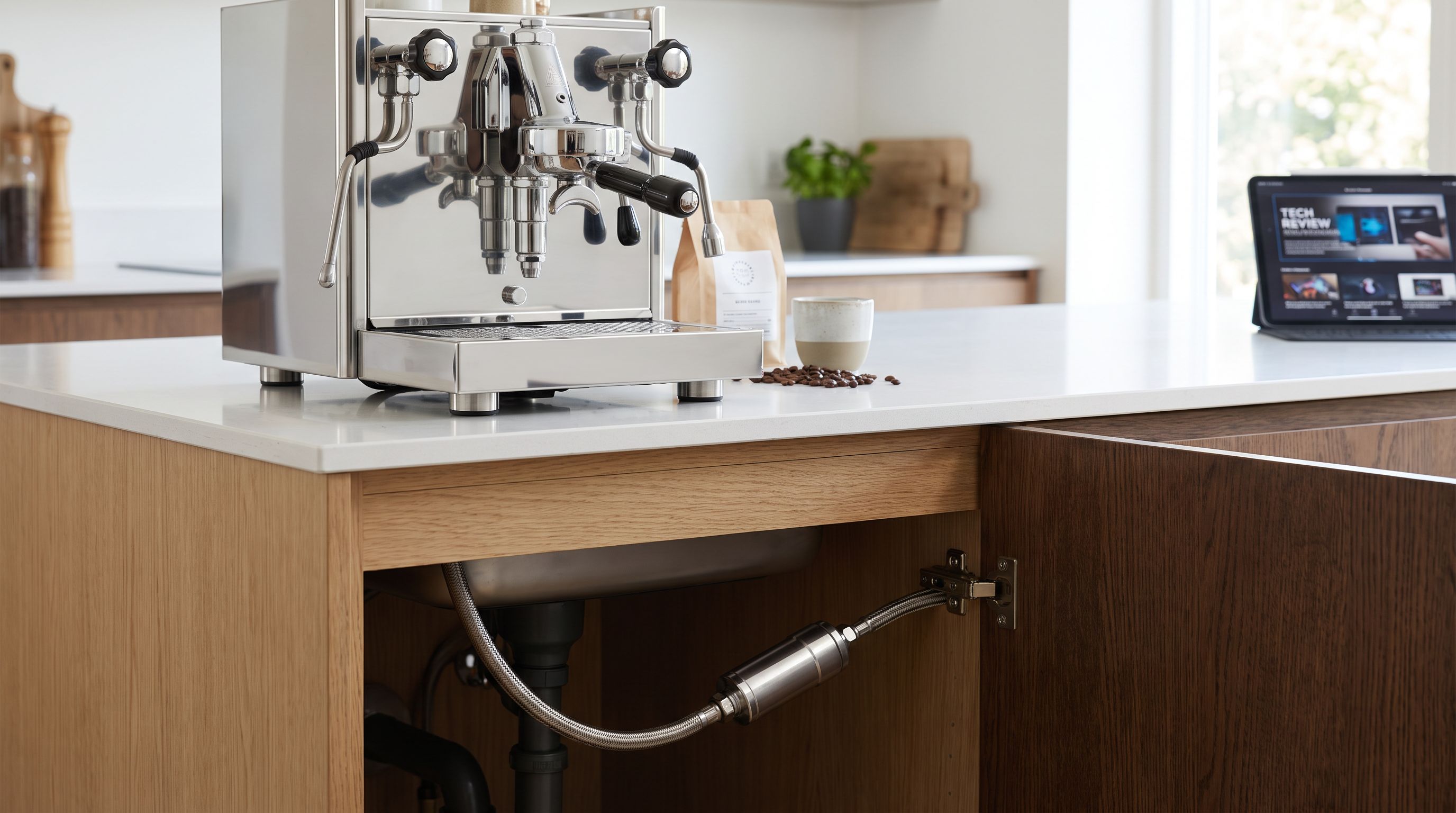
Buy a cheap hose-bib pressure gauge and measure before you buy anything else. If you're over your machine's stated maximum, you need a regulator. The Watts 263AB Water Pressure Regulator is the common, lead-free brass answer: adjustable, serviceable, and small enough to mount on the supply line inside the sink cabinet. Set it to the middle of your machine's range, not the ceiling.
A few related points people learn the hard way:
- Water hammer is real. A rotary pump's solenoid closing hard against a rigid line can knock. An arrestor or a short length of braided flexible hose absorbs it.
- Softened water is not filtered water. Ion-exchange softeners swap calcium for sodium, which protects against scale but can accelerate corrosion in boilers and tastes flat. Most espresso manufacturers specifically warn against running softened water straight in.
- RO water is too aggressive on its own. Reverse osmosis strips the minerals that make espresso taste like anything and that boiler probes need to read a water level. If you have RO, you need remineralisation.
Filtration: carbon block, scale control, or both
Your machine's boiler is the most expensive part of it, and scale kills boilers. The practical setup for most homes is a single under-sink cartridge doing chlorine/chloramine removal plus particulate filtration, and — if your water is hard — a scale-inhibiting cartridge in series or a polyphosphate dosing filter.
The 3M Aqua-Pure AP Easy Complete Water Filter System is the one we'd default to: quick-change sanitary head so you never touch the media, carbon block for chlorine and taste, and a flow rate comfortably above what an espresso machine asks for. Cartridge life is rated in gallons, so a single-machine home install lasts a long time on one cartridge — but change it on schedule anyway, because an exhausted carbon block stops protecting and starts hosting bacteria.
 Best inline filtration · 3M Aqua-Pure AP Easy Complete Water Filter System — Check price on Amazon →
Test your water hardness first with a cheap GH test kit. Under roughly 50 ppm total hardness, carbon alone is fine. Above that, add scale control. Above 150 ppm or so, consider blending RO with a mineral additive instead of trying to filter your way out of it.
Comparison: what each setup demands
| Setup | Pump type | Inlet pressure tolerance | Regulator needed? | Drain required? |
|---|---|---|---|---|
| ECM Synchronika | Rotary | Wide; tank/line selector onboard | Only if house pressure exceeds spec | No — drip tray, optional drain kit |
| Profitec Pro 700 | Rotary | Wide; gauge makes tuning easy | Usually yes above ~60 psi | No — optional drain conversion |
| Rocket Appartamento + plumb kit | Vibratory | Narrow; pump adds to line pressure | Yes, treat as mandatory | No |
| Built-in coffee system (Miele / F&P) | Varies | Per manufacturer spec | Per manual; often built in | Often yes — part of cabinetry plan |
The under-counter checklist
Before you cut anything:
- Find a cold-water source. Standard practice is a quarter-turn ball valve tee off the cold supply under the sink — the same tap point a fridge line or RO system uses. Avoid saddle valves; they're banned in many jurisdictions and they fail.
- Use braided stainless, not plastic. A braided line with proper compression or John Guest fittings is the right call on a line that will sit pressurised for years.
- Add a shutoff you can reach. You want to kill the water in two seconds without crawling.
- Route the line so the machine can move. Leave enough slack to pull the machine forward for backflushing and cleaning.
- Consider a leak detector. A battery water alarm in the cabinet costs almost nothing and catches a weeping compression fitting before the plywood does.
- Think about drainage. Most home plumb-ins skip the drain and keep emptying the drip tray. If you're plumbing a drain too, you need a proper air gap and a connection to the sink tailpiece — that's genuinely a plumber's job.
Who should skip this entirely
If you pull two to four shots a day on a dual boiler with a 2.5-litre tank, plumbing in buys you convenience and very little cup quality. Tank water, filtered properly with the right mineral profile, is often better than line water because you control it completely. Plumb in when you're running back-to-back drinks for a household, when the reservoir is awkward to access in a tight cabinet layout, or when you're already opening the wall for a renovation.
FAQ
Can I plumb in a Breville or Gaggia machine? No. Those machines have no water inlet and their vibratory pumps aren't designed for pressurised supply. Aftermarket hacks void the warranty.
Do I need a plumber? For the supply tee and a regulator, a competent DIYer with a ball-valve adapter kit can usually do it. For a drain connection or anything involving an air gap, hire one — drain work is code-regulated.
Will plumbing in make my espresso taste better? Only if your line water, after filtration, has a better mineral profile than what you were pouring in the tank. Plumbing in solves convenience and consistency, not extraction.
Can I run my machine off an RO system? Not straight. RO permeate is too low in minerals for taste, for boiler level probes, and for corrosion resistance. Blend it or add a remineralising cartridge.
How often do I change the filter? Follow the cartridge's gallon rating, but set a calendar reminder too — six to twelve months is typical for home volumes regardless of throughput.
Our picks
ECM Synchronika
Dual boiler, rotary pump, factory plumb-in kit and a tank you can switch back to in seconds.
Profitec Pro 700
Rotary-pump dual boiler with direct-connect hardware and a pressure gauge that makes dialing line pressure easy.
Rocket Espresso Appartamento 2.0 Espresso Machine | Heat Exchanger | 1.8L | (White)
E61 HX machine in a 275mm-wide body; vibe-pump plumb-in kit available for tight counters.
3M Aqua-Pure AP900 Series Whole House Water Filter Cartridge AP917HD-S
Sanitary quick-change head and carbon block cartridge sized for under-sink espresso lines.
Watts 263AB Water Pressure Regulator
Lead-free brass adjustable regulator that tames high municipal pressure before it reaches your machine.
Get the best kitchen gear deals in your inbox
Join the PrepDeck newsletter for hand-picked kitchen gear deals and new buying guides. No spam, unsubscribe anytime.
Related reads
Espresso Grinders in 2026: 5 Picks From $150 to $600
The best espresso grinder 2026 shortlist: flat vs conical burrs, stepless adjustment, retention and static compared across home grinders from $150 to $600.
Espresso Machine Water in 2026: Stop Scale Before It Starts
Espresso machine water filter hardness explained: how to test GH and KH, pick resin filters vs. remineralization packets, and match water to your boiler type in 2026.
Milk Frothing Pitcher Guide 2026: Match Spout to Steam Power
How to choose a milk frothing pitcher in 2026: spout shape, 12 vs 20 oz volume, stainless gauge and interior fill lines, matched to your machine's steam wand.