Milk Frothing Pitcher Guide 2026: Match Spout to Steam Power
How to choose a milk frothing pitcher in 2026: spout shape, 12 vs 20 oz volume, stainless gauge and interior fill lines, matched to your machine's steam wand.
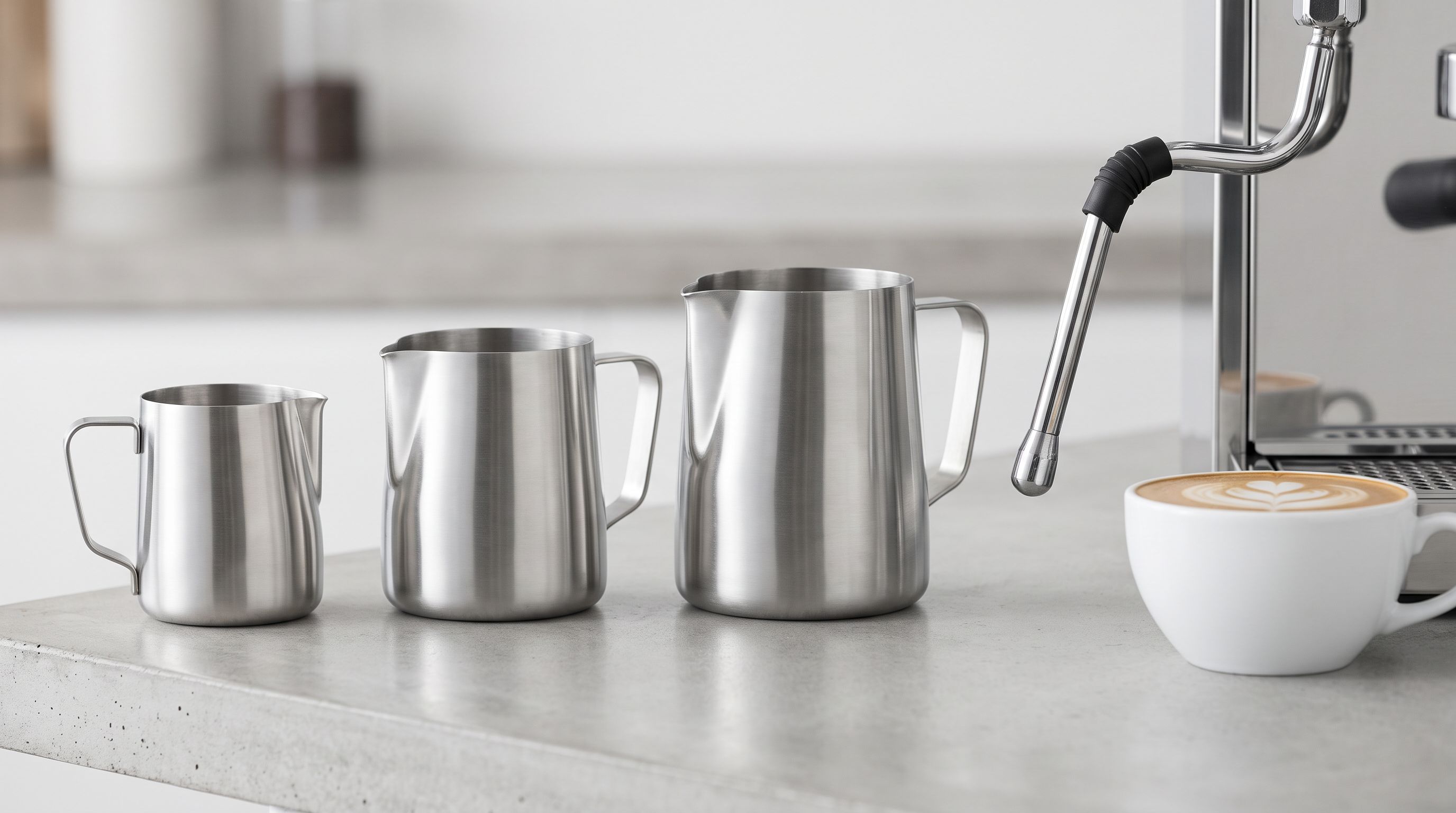
Reader-supported: we may earn a commission from links on this page, at no extra cost to you. It never affects our picks. Learn more.
Most people buy a milk frothing pitcher the way they buy a dish rack: grab whatever's cheap, move on. Then they spend six months wondering why their microfoam looks like bubble bath and their latte art dies halfway through the pour.
The pitcher matters more than almost any other accessory on the espresso bench, because it's the only part of the process you steer by hand. Its shape decides how milk circulates under the steam wand. Its spout decides whether a tulip opens or smears. Its volume decides whether you get a tight whirlpool or a lukewarm, flat pool.
Here's how to pick one that fits your machine, your cup and your skill level in 2026.
Volume first: match the pitcher to your steam wand, not your ego
The single most common mistake is buying too big. A 20 oz pitcher looks capable. On a single-boiler home machine with a modest steam wand, it's a liability — there isn't enough steam power to spin that much milk, so you get slow, noisy heating and large bubbles instead of a vortex.
The working rule: fill your pitcher between one-third and one-half full, with the milk level sitting just below the bottom of the spout before you start. That means the pitcher's rated volume should be roughly double the milk you actually need.
| Your setup | Milk per drink | Pitcher size to buy |
|---|---|---|
| Single-boiler / thermoblock, one cappuccino (5–6 oz cup) | ~4–5 oz | 10–12 oz |
| Heat-exchanger or dual boiler, one 8 oz latte | ~6 oz | 12–13 oz |
| Two drinks back to back, strong steam | ~10–12 oz | 20 oz |
| Flat whites, cortados, practice sessions | ~3–4 oz | 8–10 oz |
If you own exactly one pitcher, make it 12 oz. It handles a single latte comfortably, still spins properly with 4 oz of milk for a cortado, and nearly every latte-art tutorial on the internet is demonstrated with one. That's why the Rattleware 12 oz has been the café default for two decades — it's the size the whole craft is calibrated around.
A 20 oz pitcher like the Normcore 20 oz earns its place only as a second jug, for when you're steaming for two people and your machine genuinely has the steam pressure to move that volume.
Spout shape: the part that actually draws the art
Spouts fall into three broad shapes, and they behave differently enough that it's worth knowing which you're buying.
Rounded / classic spout
A gentle, wide curve. Milk leaves in a broader stream that's slower to build pressure. It's forgiving — if your pour angle is off by a few degrees, the pattern still lands. Classic hearts and basic rosettas come easily. Fine detail, less so. The Rattleware sits here, and that forgiveness is exactly why it suits beginners.
Sharp / fluted spout
A tighter, more defined point, often with a pronounced crease. The stream is narrower and more directional, which lets you wiggle fast without the pattern bleeding. This is the shape you want once you're attempting tulips, swans and layered rosettas. The Fellow Eddy uses a notably sharp fluted spout, and the Barista Hustle 13 oz is built around the same philosophy — a tight, symmetrical spout designed for pattern control rather than general-purpose convenience.
Wide, shallow spout
Found on cheaper jugs and some serving-focused pitchers. Pours fast, splits the stream unpredictably, and makes consistent art genuinely hard. Avoid for latte art; fine for hot chocolate.
One detail worth checking in photos and owner reviews: spout symmetry. Cheap pitchers are frequently pressed off-centre, so the spout leans a few degrees left or right. You'll compensate unconsciously and never understand why your rosetta drifts. Reviewers consistently flag symmetry as the dividing line between budget jugs that work and ones that don't — and it's the reason the Barista Hustle pitcher has a reputation it does, since symmetry is one of its stated design priorities.
Stainless gauge and why thickness cuts both ways
Pitcher walls are typically 0.6 mm to 1.0 mm stainless (usually 304 / 18-8 food grade).
- Thinner walls (around 0.6–0.7 mm) transmit heat fast. You feel the milk hitting 55°C / 130°F through your palm, which is genuinely useful for learning to steam by touch instead of by thermometer. Downside: they dent if dropped and can feel flimsy.
- Thicker walls (0.8–1.0 mm) are more durable, hold their shape, and resist the warped-spout problem after a year of knocks. They're slightly slower to telegraph temperature. The Barista Hustle pitcher is built from 0.9 mm steel; most café-grade jugs including the Rattleware sit in the thicker camp.
Neither is wrong. If you're learning temperature by hand, slightly thinner is an advantage. If your pitcher lives in a crowded drawer, go thicker.
Also note: handle-free jugs (gripped directly by the body) are a real category used by competition baristas for maximum pour control. They are not beginner gear — you need to judge temperature fast because you're holding hot metal, and they're awkward if your machine's steam wand sits in a tight space.
Interior volume markings: underrated, genuinely useful
Etched or embossed fill lines inside the pitcher are the difference between "roughly this much milk" and repeatable results. They let you pour consistently every morning, which is the only way to actually learn — you can't diagnose your technique if the variable keeps moving.
Not every pitcher has them. The Normcore 20 oz and the MHW-3BOMBER 12 oz both include interior markings, which is a meaningful advantage at their respective price points. If a pitcher you're considering doesn't have them, you can approximate by noting where the spout base sits, but markings are better.
Avoid pitchers with painted or powder-coated interiors. Exterior colour is fine and purely cosmetic; interior coatings can chip into your milk and complicate cleaning. Non-stick interior coatings (like PTFE-lined jugs) exist and have their fans for easy cleaning, but they wear and they obscure the visual cue of milk texture against bright steel.
Shape of the body: cone vs straight wall
Most quality pitchers are conical — narrower at the base, wider at the rim. That taper helps the milk roll into a vortex at lower volumes, which is exactly what a weaker home steam wand needs. A few pitchers use a more straight-sided or stepped profile; the Fellow Eddy's stepped interior is designed to influence how milk circulates as it expands.
For a home machine with modest steam, favour a classic conical body. It's the easiest shape to get spinning.
Quick buying summary
- Default choice: Rattleware 12 oz. Forgiving spout, café-proven, the size everything is taught in.
- Serious about latte art: Barista Hustle 13 oz or Fellow Eddy 12 oz — tighter spouts, better detail control.
- Second jug for two drinks: Normcore 20 oz, only if your machine has the steam to drive it.
- Spending as little as possible: MHW-3BOMBER 12 oz, which gets the fundamentals — spout form, wall thickness, fill lines — right.
Buy two eventually: a 12 oz for daily drinks and either an 8–10 oz for cortado practice or a 20 oz for guests. They're inexpensive relative to everything else on an espresso bench, and having the right size is worth more than any technique video.
FAQ
Can I use a milk frothing pitcher on an induction hob to heat milk? Only if it's magnetic stainless. Most 304/18-8 pitchers are non-magnetic austenitic steel and won't work on induction. Test with a fridge magnet. Also, thin-walled pitchers scorch milk easily on direct heat — they're designed for steam, not stovetops.
Does the pitcher need to be cold before steaming? It helps. Starting with a chilled pitcher and cold milk gives you more time in the stretching phase before the milk hits texture-setting temperature, which is especially valuable if you're still learning. Some baristas keep their pitcher in the fridge.
What size for a cappuccino in a 6 oz cup? A 12 oz pitcher with about 4–5 oz of milk. A 20 oz pitcher at that fill level will struggle to spin on most home machines.
Are 304 and 18-8 stainless different? Practically, no — 18-8 describes the chromium/nickel content of 304-series steel. Both are standard food-grade and fine for milk.
Is a non-stick or coated interior worth it? It makes rinsing easier, but coatings wear over time and hide the visual cues of milk texture against bare steel. For learning latte art, plain polished stainless is the better choice.
How do I know if a cheap pitcher is any good? Check owner photos for spout symmetry, look for a stated wall thickness (0.8 mm or more is reassuring), confirm the interior is uncoated steel, and look for internal fill markings. Those four things separate usable budget jugs from decorative ones.
Our picks

Rattleware 12 Oz Etched Milk Frothing Pitcher Latte Art Espresso Stainless | Etched latte art guide
The café standard: heavy-gauge steel, balanced handle and a rounded spout that forgives sloppy pours.

Fellow Eddy Milk Frothing Pitcher 12 oz, Fluted Spout for Latte Art
Sharp fluted spout and a stepped interior for precise texturing — the enthusiast's upgrade.
Barista Hustle Milk Pitcher 13 oz
0.9 mm symmetrical body with a tight spout designed specifically for pattern control.

Normcore Handleless Milk Frothing Jug, Milk Pitcher 20.3 oz, Milk Frother Steamer Cup Stainless Steel Espresso Cup, Round Spout, Green, 600 ml
Larger capacity with internal volume markings so you stop guessing how much milk to pour.

MHW-3BOMBER Milk Frothing Pitcher 12oz/350ml Milk Frother Cup Espresso Steaming Pitcher Stainless Steel Milk Frother Cup Barista Latte Art Round Spout Latte Art Pitcher P7121S
Surprisingly well-formed spout and thick walls for the money, with clear interior fill lines.
Get the best kitchen gear deals in your inbox
Join the PrepDeck newsletter for hand-picked kitchen gear deals and new buying guides. No spam, unsubscribe anytime.
Related reads
Plumbed In Espresso Machine 2026: What Your Sink Needs
Thinking of plumbing in your espresso machine in 2026? Here's the line pressure, regulator, filtration and machine compatibility you actually need under the counter.
Espresso Grinders in 2026: 5 Picks From $150 to $600
The best espresso grinder 2026 shortlist: flat vs conical burrs, stepless adjustment, retention and static compared across home grinders from $150 to $600.
Single Dose Coffee Grinder 2026: Ranked by Retention
We compared single dose coffee grinders for 2026 on grounds retention, burr size and bellows design — picks from $250 to $900 for home espresso.