Induction Compatibility, Explained: What Actually Works
Why some "induction-ready" pans heat slowly, buzz, or trip error codes — plus the magnet test, base construction basics, and which cookware genuinely performs in 2026.
Reader-supported: we may earn a commission from links on this page, at no extra cost to you. It never affects our picks. Learn more.
The pan sticks to the magnet. So why is the water still not boiling?
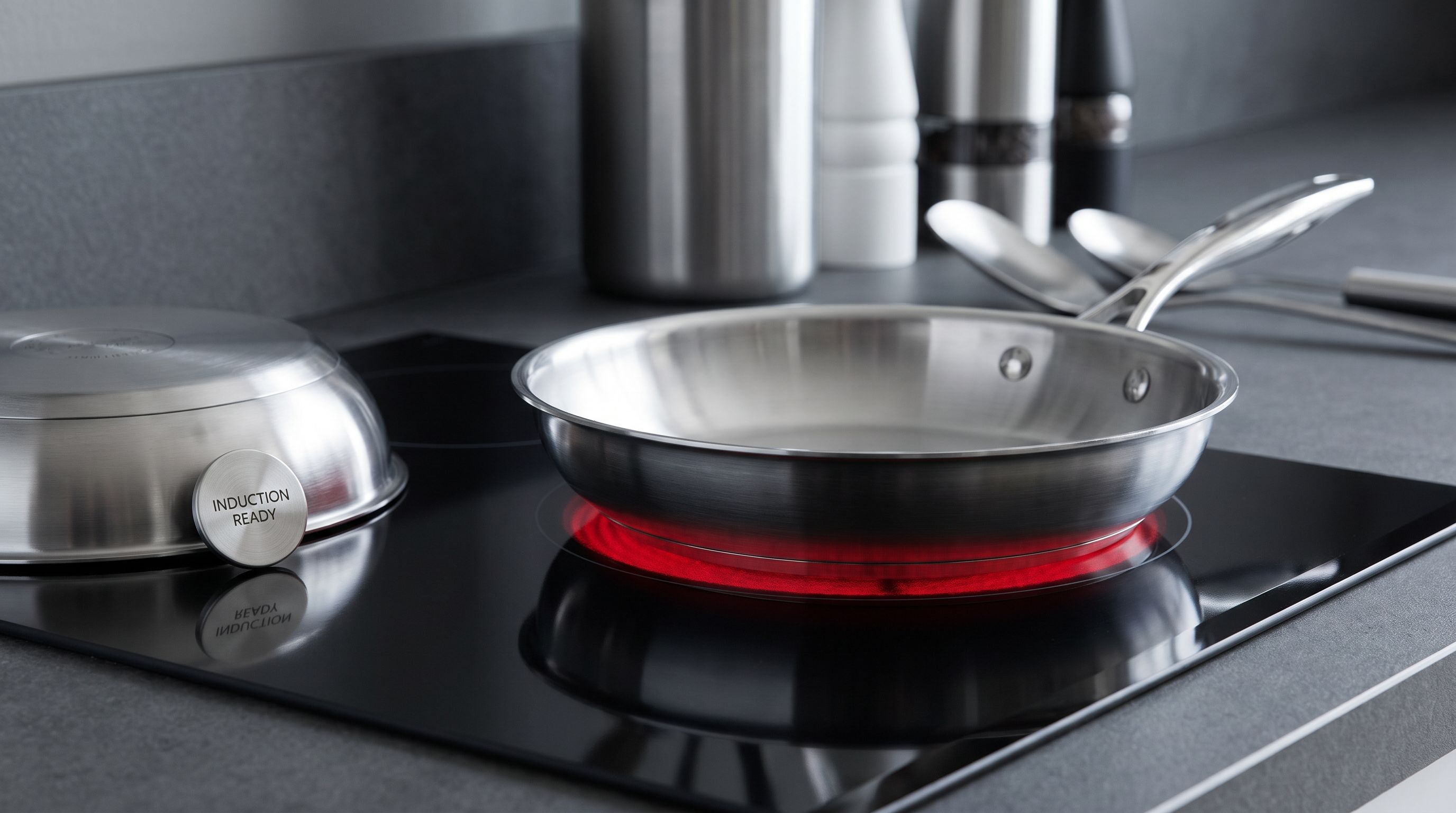
Induction is the most literal-minded cooking technology in your kitchen. A coil under the glass generates an oscillating magnetic field; that field induces eddy currents in a ferromagnetic pan; those currents meet electrical resistance and the pan heats itself. There is no flame, no radiant element, no thermal middleman. If the pan can't couple with the field, nothing happens at all.
That binary quality is what makes induction feel foolproof — and what makes "induction-ready" labeling so slippery. A pan can technically be compatible (the magnet sticks) and still underperform badly: heating slowly, buzzing at high power, throwing an error code, or scorching a ring the exact diameter of the coil. Compatibility and performance are two different questions, and most marketing copy only answers the first one.
What's actually happening now
Two trends have collided. Induction installs have grown fast in the US as electrification incentives and portable single-burner units lowered the barrier to entry, and cookware brands responded by stamping "induction compatible" on almost everything. The result is a market where the label is close to meaningless as a performance signal, because it describes a pass/fail magnetic test rather than how well a pan works.
The physics hasn't moved. As multiple 2026 cookware roundups restate, cast iron and magnetic stainless steel are the ideal materials, while aluminum, copper, titanium, glass and ceramic are non-magnetic and won't couple on their own. What changed is how manufacturers get around that. Aluminum and copper pans are now routinely fitted with a bonded ferrous disc on the bottom — a sandwich of magnetic stainless pressed, impact-bonded, or brazed onto the base. That disc is what makes the pan "induction compatible." It's also where most of the real-world problems start.
Three failure modes show up repeatedly in reviews and owner reports:
Disc diameter mismatch. The induction coil heats what's directly above it. If the bonded disc is noticeably smaller than the pan's cooking surface — common on cheaper aluminum pans and some enameled pieces — heat enters in a narrow ring and has to conduct outward through thinner material. You get a hot center and cool edges.
Minimum detection size. Most hobs need a certain base diameter to register a pan at all, often in the 10–12 cm range for standard zones, and small moka pots, milk pans and single-egg skillets frequently fall below it. The burner doesn't malfunction; it simply never turns on.
Thin or warped bases. Induction is unforgiving of a base that isn't dead flat against the glass. A warped pan loses contact, couples unevenly, and on many hobs will rattle or buzz audibly as the base vibrates in the alternating field. Thin stamped stainless amplifies this; thick clad and cast iron don't.
There's one more wrinkle worth knowing: not all stainless steel is magnetic. Austenitic grades such as 18/10 (often marked 304) are largely non-magnetic, while ferritic grades like 430 are. That's why a premium 18/10 interior pan still needs a magnetic exterior layer or base plate to work — and why "stainless steel" alone tells you nothing about induction readiness.
The real players and what's shipping
The brands that perform well on induction tend to share one trait: the magnetic layer is part of the pan's structure, not an afterthought glued to the bottom.
Cast iron is the simplest case. Lodge skillets and Dutch ovens are solid ferrous metal throughout, so coupling happens across the entire base with no bonded joint to delaminate. Enameled cast iron behaves the same way magnetically, since the enamel is just a glass coating over the same iron body. The trade-off is mass and thermal lag — cast iron is slow to respond to the near-instant power changes induction is famous for, which partly cancels induction's best feature.
Fully clad stainless is the all-round answer. In tri-ply and five-ply construction, an aluminum (or aluminum-plus-copper) core is bonded between layers of stainless, with a magnetic grade on the outside. Because the cladding wraps the whole body, the ferrous surface is as wide as the pan base and there's no separate disc. The Tramontina Tri-Ply Clad line is the most frequently cited value option in this category, and community recommendations consistently group it with Duxtop as the midrange default — notable because Duxtop also sells portable induction burners, so its Duxtop Professional Stainless Steel sets are designed around typical coil geometry.
Nonstick is where buyers get burned most often, because the nonstick body is usually aluminum and therefore needs help. Recent 2026 nonstick-for-induction roundups repeatedly name All-Clad HA1, GreenPan Valencia Pro, Zwilling Madura Plus, Made In Nonstick, and Tramontina Professional as lines with proper induction bases. The All-Clad HA1 Hard Anodized Nonstick pans are the common reference point: hard-anodized aluminum body with a bonded stainless base plate. Worth being clear-eyed, though — the induction base doesn't change nonstick's real limitation, which is coating lifespan. Any nonstick coating degrades with heat and abrasion, and induction's rapid, concentrated heating makes overheating an empty pan easier than on gas.
| Material / construction | Couples with induction? | Typical real-world weakness |
|---|---|---|
| Solid cast iron (bare or enameled) | Yes, fully | Slow to respond; heavy; can scratch glass if dragged |
| Fully clad tri-ply / 5-ply stainless | Yes, full base width | Costs more than disc-bottom pans |
| Disc-bottom stainless or aluminum | Yes, only over the disc | Disc may be smaller than pan; edge heating lags |
| Hard-anodized nonstick with bonded base | Yes, over the base plate | Coating wear, not compatibility, is the lifespan limit |
| 18/10 (304) stainless with no magnetic layer | Often no | Looks premium, won't couple |
| Aluminum, copper, glass, ceramic (uncoated) | No | Needs a bonded ferrous base to work at all |
| Carbon steel | Yes, fully | Needs seasoning; thin gauges can warp |
What it means if you're shopping today
Do the magnet test first, and do it properly. A refrigerator magnet pressed to the center of the base should grab firmly, not cling weakly. Then slide it toward the rim: if the pull dies off before you reach the edge, you've found a bonded disc narrower than the pan, and you should expect uneven heating.
Beyond that, a few checks separate a pan that works from one that works well. Lay a straightedge or ruler across the base — daylight under the middle means a warp that will cost you contact and may cause buzzing. Compare the flat base diameter to your hob's marked zone; matching the two is the single easiest way to avoid hot rings. And weigh the pan in your hand: on induction, base thickness is doing the job gas burners used to do by spreading flame, so flimsy bases translate directly to scorched spots.
For existing cookware, run the magnet across everything you own before buying anything. Plenty of kitchens already contain more induction-ready pans than their owners realize — and a few prized aluminum or copper pieces that simply never will be.
What to watch next
Three things are worth tracking through 2026. First, hob-side intelligence: more cooktops now ship with pan-detection and temperature-sensing features, and some systems use probes or sensors to regulate pan temperature rather than power level, which shifts some of the burden off cookware construction. Second, base-geometry standardization — as induction becomes the default in new builds, expect more explicit disclosure of magnetic base diameter rather than a vague compatibility logo. Third, the 120V plug-in induction range category, including battery-assisted models from newer entrants, which is making induction viable in kitchens without a 240V circuit and will push more households into this compatibility question.
None of that changes the core rule. Induction heats the pan, so the pan is the appliance. Buy base construction, not badges.
FAQ
Will a magnet sticking guarantee good performance? No. It confirms the base is ferromagnetic, which is necessary but not sufficient. Disc width, base flatness and thickness determine how evenly that heat spreads.
Why does my pan buzz or hum on high power? Buzzing is commonly reported with multi-layer or disc-bottom pans, where bonded layers vibrate slightly in the alternating field. Thicker, fully clad or solid cast iron bases generally stay quieter.
My hob says "no pan detected" with a small saucepan. Is it broken? Usually not. Most zones require a minimum base diameter to register a load, and small moka pots or butter warmers often fall under it. Interface discs exist as a workaround, though they add thermal lag.
Is cast iron bad for glass induction tops? It's compatible, but dragging a rough cast iron base across glass can scratch it. Lift, don't slide.
Does induction kill nonstick coatings faster? The compatibility layer isn't the issue; heat is. Induction raises pan temperature quickly, so an empty preheating nonstick pan can exceed safe coating temperatures sooner than on a gas flame. Preheat gently and on lower settings.
Our picks

Lodge Pre-Seasoned Cast Iron Skillet with Silicone Handle Holder, 12 Inches
Solid ferrous iron means full magnetic coupling edge to edge — no bonded disc to fail.

Tramontina Signature Tri-Ply Clad Stainless Steel 12-Inch Large Frying Pan
Magnetic stainless exterior wrapped around an aluminum core — clad construction, not a bonded disc.

All-Clad HA1® Nonstick 8-Piece Pots & Pans Set, Induction Ready
Hard-anodized aluminum with a bonded stainless base plate designed for induction hobs.

duxtop Stainless Steel Pots and Pans Set, 17PC Induction Cookware Set
Impact-bonded magnetic base sized for common hob coils, from a brand that sells the burners too.
Get the best kitchen gear deals in your inbox
Join the PrepDeck newsletter for hand-picked kitchen gear deals and new buying guides. No spam, unsubscribe anytime.
Related reads
Cookware Sets Under $500 in 2026: The Piece-Count Math
The best cookware set under 500 in 2026, judged by usable pans — not padded lid counts. Cladding, oven limits, and induction compatibility compared.
Hard Anodized vs Stainless Cookware in 2026: Who Wins?
Hard anodized vs stainless cookware in 2026: how each handles heat, oven limits, induction and years of wear — plus which sets are worth buying.
Glass Top Stove Cookware in 2026: 5 Picks That Won't Scratch
The best cookware for a glass top stove in 2026, ranked by base flatness, weight, and scratch risk — plus which pans to keep off a smooth-top range entirely.