Pellet Grill Pellets in 2026: Match Wood to Your Auger
The best wood pellets for pellet grills in 2026, sorted by hardwood species, ash content and burn rate — so you match fuel to your auger, hopper and cook style.
Reader-supported: we may earn a commission from links on this page, at no extra cost to you. It never affects our picks. Learn more.
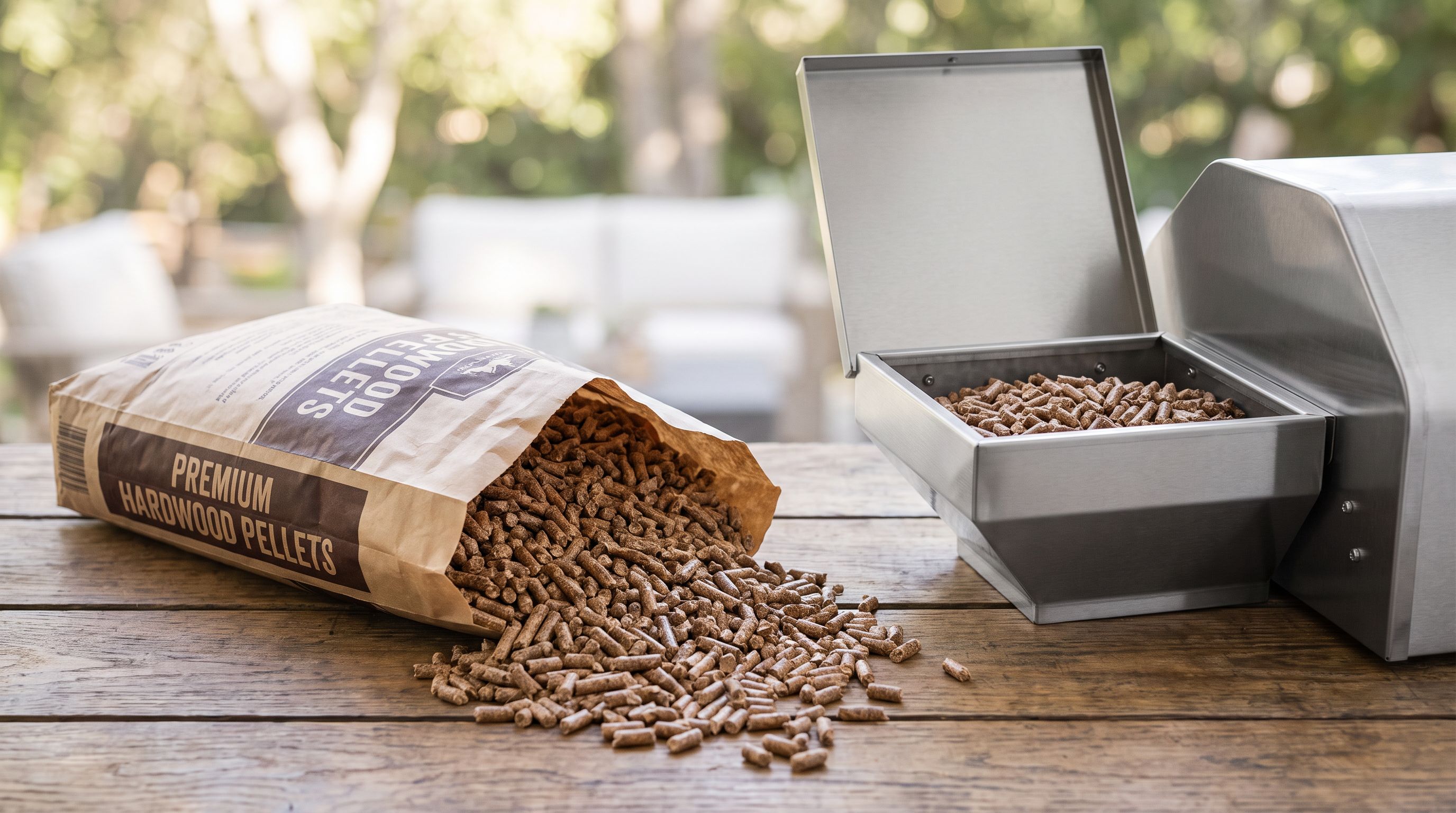
Pellets are the only consumable your pellet grill actually eats, and they're the variable most owners ignore. Swap brands and the same grill at the same setpoint can run 15°F hotter, burn through a third more fuel, and leave you scraping a fire pot full of ash halfway through a brisket. The differences come down to three things: what hardwood is actually in the bag, how much moisture and ash it carries, and how consistently the pellets are extruded so your auger can meter them.
Here's how to read a bag of pellets like a spec sheet, and which brands are worth loading in 2026.
The three specs that actually matter
Hardwood species — and whether it's really in there
Most BBQ pellets are made from one of two philosophies. Flavor-named blends like Traeger Signature Blend or Camp Chef Competition Blend are genuine mixes of hardwoods — typically hickory, maple and cherry. Base-wood pellets are a different animal: a large share of budget "apple" or "mesquite" pellets are mostly oak or alder with flavor wood added, because oak is cheap, dense and burns beautifully.
That's not inherently a scam — oak is an excellent heat wood and plenty of competition cooks like a neutral base. It only matters if you're paying a premium for cherry and getting oak. Brands that state "100% of the named wood," like Lumber Jack, and blends that publish their exact species list, like CookinPellets 40PM Perfect Mix (hickory, cherry, hard maple, apple — no filler oak or alder), take the guesswork out.
BTU per pound: it's really about density and moisture
Hardwood pellets generally land in the 8,000–8,500 BTU per pound range, and the species differences are smaller than marketing suggests. Dense woods like hickory, oak and hard maple sit at the top; softer fruitwoods like apple and cherry run slightly lower. The much bigger lever is moisture content. Pellets at 5–6% moisture light fast and burn hot; pellets that have sat in a humid garage and crept up past 10% will smolder, swing your temps, and in bad cases swell enough to jam an auger.
Practical translation: a heat-forward wood (oak, hickory, mesquite) gets a grill to 450°F+ for searing with less hopper draw. Fruitwoods are better suited to low-and-slow at 225–275°F where BTU density matters less than flavor.
Ash content — the spec that decides your cleaning schedule
Ash is the non-combustible mineral left behind, and it's mostly a function of how much bark and debris went into the mill. Premium pellets typically claim under 1% ash; cheap hardwood fuel pellets (the heating-stove kind) can run several times that. High ash means a fire pot that fills, a weak flame, temperature drops, and in the worst case a flameout mid-cook. If you're doing 10-hour overnight smokes, low ash isn't a luxury — it's the difference between finishing and not.
Note the nuance: Lumber Jack leaves bark in deliberately, because bark carries a lot of the smoke flavor compounds. You get more smoke and slightly more ash. That's a trade worth making for flavor-driven cooks, less so if you never want to open the barrel.
Matching pellets to your grill
Narrow augers and older Traeger-style systems are the fussiest. They want uniform pellet diameter (around 1/4 inch) and minimal sawdust fines. Bags that arrive crushed, or pellets that have absorbed moisture and crumbled, are the #1 cause of auger jams. Traeger Signature Blend is a safe default here simply because it's made to that machine's tolerances and sold everywhere.
High-output grills with large fire pots — Camp Chef Woodwind, recteq, newer Pit Boss models — can handle bark-in pellets and higher-smoke blends without choking, and they benefit most from a dense heat wood when you want to run hot.
Searing at 450–500°F burns fuel roughly two to three times faster than a 225°F smoke. If you cook hot regularly, buy by the 40 lb bag. CookinPellets 40PM Perfect Mix is the obvious candidate: one species blend, no switching, and enough volume that a pork butt and a cook-off weekend don't wipe you out.
How the 2026 picks compare
| Pellet | Species | Smoke intensity | Best use | Bag format |
|---|---|---|---|---|
| Lumber Jack Competition Blend | Maple, hickory, cherry (bark included) | Strong | All-around smoking, flavor-first cooks | 20 lb |
| CookinPellets 40PM Perfect Mix | Hickory, cherry, hard maple, apple — no filler | Medium-strong | Long briskets, overnight pork | 40 lb |
| Bear Mountain Premium Oak | 100% oak | Medium | High-heat cooking, steady temps, beef | 20 lb |
| Traeger Signature Blend | Hickory, maple, cherry | Medium | Daily driver for Traeger owners, poultry and pork | 20 lb |
| Camp Chef Competition Blend | Cherry, maple, hickory | Mild-medium | Value cooking, chicken, veg, mixed menus | 20 lb |
The picks, and who each one is for
Lumber Jack Competition Blend BBQ Pellets is our best overall because it solves the honesty problem. Lumber Jack mills the named wood rather than dressing up an oak base, and it leaves the bark in — which is why owners consistently describe its smoke as noticeably heavier than the big-box blends. On pellet grill forums it's one of the two brands that come up over and over. If your complaint about your grill is "not enough smoke flavor," start here before you buy a smoke tube.
 Best overall · Lumber Jack Competition Blend BBQ Pellets — Check price on Amazon →
CookinPellets 40PM Perfect Mix Hardwood Pellets is the long-cook pick, and the other brand that dominates owner recommendations. Four real hardwoods, explicitly no oak or alder filler, and a 40 lb bag that means you aren't babysitting a hopper or splicing in a different brand at hour seven. The hickory-cherry backbone is forgiving across pork, beef and poultry, so it works as a single-bag solution.
Bear Mountain Premium Oak BBQ Wood Pellets is the burn-rate pick. In independent side-by-side testing, Bear Mountain's oak posted one of the best burn rates of the field — better than Traeger and Weber in that comparison — which is exactly what you want when you're trying to hold 275°F in the wind or push a grill to searing temps. Oak is also the most food-neutral of the serious smoke woods: it won't overwhelm fish or vegetables the way mesquite will.
 Best burn rate · Bear Mountain Premium Oak BBQ Wood Pellets — Check price on Amazon →
Traeger Signature Blend Hardwood Pellets earns its place on compatibility and availability. If you own a Traeger and you've had auger trouble, standardizing on Traeger's own pellets removes a variable. The hickory-maple-cherry profile is deliberately middle-of-the-road — a fine everyday pellet, just not the one to buy if you want aggressive smoke.
 Best for Traeger owners · Traeger Signature Blend Hardwood Pellets — Check price on Amazon →
Camp Chef Premium Hardwood Pellets Competition Blend is the value play. Cherry, maple and hickory, low ash, tightly sized pellets, and a price per pound that makes weeknight chicken thighs guilt-free. It's milder than Lumber Jack, which is actually an advantage for shorter cooks where heavy smoke turns bitter.
Storage is half the battle
Buy the best pellets you want; if you store them badly, you own bad pellets. Keep them in a sealed container — a 5-gallon bucket with a gasket lid or a dedicated pellet bin — off the concrete floor, away from humidity. Empty your hopper if the grill will sit for more than a week or two, especially outdoors. Swollen, crumbly pellets are the single most common cause of a grill that won't hold temp.
And vacuum the fire pot every few cooks. A low-ash pellet buys you time; it doesn't buy you immunity.
FAQ
Can I mix brands in one hopper? Yes, and most people do when a bag runs out mid-cook. Mixing species changes flavor, not function, as long as pellet diameter is similar. What you should avoid is mixing in heating pellets — they're made from softwood and non-food-safe binders.
Are heating stove pellets safe in a grill? No. Softwood heating pellets can contain binders and additives not intended for food contact, and they produce far more ash. Use only food-grade BBQ hardwood pellets.
How many pounds will a long smoke use? Rough planning number: 1–2 lb per hour at 225–250°F, and 2–3+ lb per hour at high heat, depending on the grill's insulation and the outside temperature. A 12-hour brisket in cold weather can easily eat 20 lb.
Does mesquite belong in a pellet grill? Sparingly. Mesquite is intense and turns acrid over long cooks. It's best for short, hot cooks on beef — or as part of a blend rather than straight.
Do pellets expire? Not in a shelf-life sense, but they degrade with moisture. Kept dry and sealed, a bag stays good for years. Left in a damp hopper, it can be ruined in a month.
Our picks
Lumber Jack Competition Blend Maple-Hickory-Cherry BBQ Grilling Pellets – 20 lbs.
100% of the named hardwood with bark included — strong smoke flavor and a clean, predictable burn.
CookinPellets 40PM Perfect Mix Hardwood Pellets
Hickory, cherry, hard maple and apple with no filler oak or alder, in a 40 lb bag that outlasts a brisket.
Bear Mountain Oak Wood Pellets for Smoker, Grill, & BBQ, 40lb Bag
Low-moisture oak that burns hot and steady — a top performer for temperature stability in independent testing.
Traeger Grills Signature Blend 100% All-Natural Wood Pellets for Smokers and Pellet Grills, BBQ, Bake, Roast, 18 lb. Bag (Pack of 3)
Hickory, maple and cherry blend tuned to Traeger augers and controllers; widely stocked and consistent.

Camp Chef Competition Blend BBQ Pellets, Hardwood Pellets for Grill, Smoke, Bake, Roast, Braise and BBQ, 20 lb. Bag
Cherry, maple and hickory at a friendly price per pound, with low ash and tight pellet sizing.
Get the best kitchen gear deals in your inbox
Join the PrepDeck newsletter for hand-picked kitchen gear deals and new buying guides. No spam, unsubscribe anytime.
Related reads
Pellet Grill Griddle Combo or Two Machines? 2026 Guide
Pellet grill griddle combo vs a dedicated pellet smoker in 2026: hopper size, griddle temps, cook surface and which one actually earns the patio slot.
Flat Top Griddle vs Pellet Grill in 2026: Only Room for One
Flat top griddle vs pellet grill in 2026: we compare fuel cost, cook surface, cleanup, winter use and long-term durability to help you pick the one that earns your patio.
Pellet Smokers in 2026: 5 Picks From $500 to $1,800
The best pellet smoker 2026 picks compared on hopper capacity, cook area, temperature swing and WiFi control — from budget Pit Boss to Weber and Recteq.