Home Coffee Roasters in 2026: Pick by Batch Size First
The best home coffee roaster 2026 guide that starts with batch weight and venting — drum vs fluid bed picks from 120g samples to 1kg garage roasts.
Reader-supported: we may earn a commission from links on this page, at no extra cost to you. It never affects our picks. Learn more.
Home roasting advice online tends to collapse into a single recommendation, which is exactly the wrong shape for this category. The right machine depends on three things an AI summary can't know about you: how much green coffee you actually go through in a week, where the smoke goes, and how much control you want over the roast curve.
Get those three right and almost any decent roaster will make good coffee. Get them wrong and you'll own a 1 kg machine you can't legally run indoors, or a 4 oz machine you're firing four times every Sunday.
Start with batch weight, not features
Work backwards from consumption. A rough rule: green coffee loses 14–18% of its weight as moisture during roasting, so 250 g of green yields roughly 205–215 g roasted.
- Two people, ~2 cups a day each: about 250–350 g roasted per week. One 500 g batch every 10 days, or two 250 g batches a week.
- Espresso household or a heavy drip habit: 500 g+ roasted weekly.
- Sample roasting / chasing origins: 100–150 g at a time so you can burn through greens quickly without staling a kilo.
Then add the practical constraint: most home roasters want you to fill the drum or chamber to 60–100% of rated capacity. Under-loading a big drum gives you poor bean-mass thermal momentum and scorchy, uneven roasts. A 1 kg machine run at 300 g is not a good 300 g machine.
That's why batch size is the first filter. The Fresh Roast SR540 and SR800 are the same control platform at two capacities — roughly 4 oz and 8 oz of green respectively — and people regularly buy the wrong one because they shopped on features.
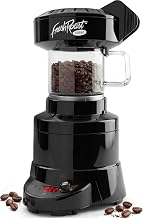 Budget pick · Fresh Roast SR540 — Check price on Amazon →
Venting: the constraint that disqualifies machines
Roasting produces smoke and chaff, and from first crack onward the smoke volume climbs sharply on darker roasts. This is where kitchens and garages diverge.
Fluid-bed (air) roasters like the Fresh Roast SR540 and SR800 blow hot air up through the bean mass. Chaff separates into a chaff collector, and smoke exits the top. They're small enough to sit under a decent range hood that vents outside — not a recirculating one. Many owners put them in a garage or on a porch instead, which also solves the chaff mess.
Catalytic-suppression drum roasters are the apartment answer. The Behmor 2000AB Plus roasts up to a pound in a rotating drum and passes exhaust through a heated catalytic element that burns off much of the smoke. It's not magic — dark roasts still produce visible smoke — but it's the one 1 lb-class machine that a lot of people genuinely run on a kitchen counter without ducting.
Dedicated venting machines are the serious tier. The Aillio Bullet R1 V2 is a 1 kg drum roaster that expects you to duct its exhaust outdoors or into a proper hood. Plan for a 4-inch outlet, a run of ducting, and a location where that's possible — a garage with a window, a basement with a dryer-style vent, a dedicated utility room. It also draws serious current, so check your circuit before you buy.
 Best overall · Aillio Bullet R1 V2 — Check price on Amazon →
Gas drum roasters like the Kaldi Wide sit on a camping burner and are effectively outdoor or well-ventilated-garage equipment. No electronics, no firmware, no catalytic cartridge to replace — a trier port, a crank, and your eyes and ears.
Roast-profile control: three real levels
- Set-and-forget with adjustment. Behmor's preset programs with manual override during the roast. You can extend time and shift power, but you're nudging a program, not drawing a curve.
- Live manual control. Fresh Roast SR540 and SR800 give you independent fan and heat settings you change second by second, plus a time knob. With a bean-probe thermometer or the popular aftermarket controllers, you can log and repeat profiles surprisingly tightly for an air roaster.
- Full profile software. The Aillio Bullet R1 V2 logs bean temperature, rate of rise, drum speed, fan and power into its own app, and can replay a saved profile. This is the level where you can actually chase a specific development-time ratio and hit it again next week.
Manual drum roasters like the Kaldi Wide sit outside this ladder: zero automation, maximum feedback. You learn roasting by sound and smell, which is a legitimate — and cheap — path.
Comparison table
| Roaster | Type | Green batch (approx.) | Venting needs | Profile control |
|---|---|---|---|---|
| Aillio Bullet R1 V2 | Electric drum, IR | Up to ~1 kg | Duct outdoors or strong hood | Full software logging + profile replay |
| Behmor 2000AB Plus | Electric drum | Up to ~1 lb | Catalytic suppression; counter-friendly | Presets with live override |
| Fresh Roast SR800 | Fluid bed | ~8 oz | Vented hood, garage or outdoors | Live fan + heat, manual |
| Fresh Roast SR540 | Fluid bed | ~4 oz | Vented hood, garage or outdoors | Live fan + heat, manual |
| Kaldi Wide | Manual gas drum | Under ~1 lb | Outdoors / open garage | Entirely manual, trier port |
Capacities are manufacturer-stated ranges; usable batch size varies by bean density and target roast level. Lighter, denser beans and darker roasts both shift the practical maximum.
Which one fits your kitchen
You're new and want coffee next week. Fresh Roast SR800. Roasts run roughly 8–12 minutes, cooling is built in, cleanup is a chaff collector and a quick wipe. It's a small enough commitment that if you discover you hate roasting, you've lost very little. If your weekly volume is modest or you want to sample lots of origins, the Fresh Roast SR540 does the same job at half the batch.
You live in an apartment and want drum-roast character. Behmor 2000AB Plus. The catalytic system plus a 1 lb drum is a combination nothing else really offers at this size, and drum roasting's slower conduction-heavy profile suits chocolatey, body-forward coffees.
You're roasting for a household, a cafe-at-home espresso habit, or friends. Aillio Bullet R1 V2. One kilo per batch, repeatable logged profiles, and a build meant for frequent cycles. Treat the ducting and electrical install as part of the purchase decision, not an afterthought.
You want to learn the craft and have outdoor space. Kaldi Wide. A gas burner, a thermometer, and a trier teach you more about roast development in a month than any preset program will.
Things to budget for beyond the machine
- Green coffee in quantity. Buying 5 lb bags is where home roasting starts paying off versus bagged specialty coffee.
- A cooling solution. Air roasters cool in-chamber; drum roasters benefit from a metal colander and a fan, or the machine's own tray.
- A kitchen scale to 1 g and a notebook or app for logging charge weight, end weight, times to first crack and drop.
- A chaff plan. Chaff is light, static-prone and travels. Roast somewhere you can sweep.
- Consumables. Behmor catalytic elements and Bullet chaff filters wear; check availability before committing.
FAQ
How long does home-roasted coffee need to rest? Most coffees need 3–10 days off-roast, with espresso typically wanting the longer end. Plan your batch cadence so you always have resting stock behind your drinking stock.
Can I roast indoors without a range hood? Honestly, only with a smoke-suppressing machine like the Behmor 2000AB Plus, and even then stick to lighter and medium roasts. Fluid-bed roasters under a recirculating hood will set off your smoke alarm.
Is a fluid-bed roaster worse than a drum? Different, not worse. Air roasters are convection-dominant, which tends to give bright, clean, high-clarity cups and fast roasts. Drums add conduction and thermal mass, which generally builds more body and sweetness. Plenty of serious roasters prefer the SR800 for washed Ethiopians.
Do I need a bean probe thermometer? Not to start. Once you want repeatability, yes — temperature and rate-of-rise data is what turns a lucky roast into a repeatable one. The Aillio Bullet R1 V2 has this built in.
What's the single most common buying mistake? Buying too big. A roaster you can't vent, or one that needs 700 g to run well when you drink 250 g a week, becomes shelf furniture. Size to your actual consumption and upgrade later.
Our picks
Bean Deflector Compatible With Aillio Bullet R1 Coffee Bean Roaster
A true 1 kg drum roaster with data logging and profile control — the closest thing to a shop machine indoors.
Fresh Roast SR800
Up to ~8 oz green per batch, real-time fan and heat control, and roasts finish in under 12 minutes.
Behmor 2000AB Plus
1 lb drum capacity with a smoke-suppression catalytic system, so it runs on a kitchen counter.
Fresh Roast SR540 Automatic Coffee Bean Roaster | Roast Coffee At Home | Variable Heat Settings | Convection Fan Control | Digital Status Display | Speed Roasting System | The Freshest Roast On Earth
Same controls as the SR800 in a smaller 4 oz body — ideal for sample roasting and single-origin rotation.

KALDI WIDE Home Coffee Gas Roaster - 300g Capacity with Full Package Accessories. Gas burner required, No thermocouples supported.
Gas-burner drum with a trier port and no electronics to fail — total hands-on control for under-a-pound batches.
Get the best kitchen gear deals in your inbox
Join the PrepDeck newsletter for hand-picked kitchen gear deals and new buying guides. No spam, unsubscribe anytime.
Related reads
Single Dose Coffee Grinder 2026: Ranked by Retention
We compared single dose coffee grinders for 2026 on grounds retention, burr size and bellows design — picks from $250 to $900 for home espresso.
Turkish & Moka Grinders in 2026: Picks by Fineness Step
The best grinder for Turkish coffee 2026 isn't about brand — it's about burr type and step size. Our picks for powder-fine Turkish, moka and espresso grinds.
SCA Certified Coffee Maker 2026: Which One Fits Your Counter?
Compare SCA golden-cup certified brewers for 2026 on brew temperature hold, shower head design and carafe type — and find the right upgrade from a basic drip machine.