Cast Iron Bakeware in 2026: Preheat Mass Is the Real Spec
Cast iron bakeware in 2026, ranked by preheat mass and oven rack clearance — loaf, cornbread and pizza pans compared against steel and ceramic for crust.
Reader-supported: we may earn a commission from links on this page, at no extra cost to you. It never affects our picks. Learn more.
Cast iron bakeware is having a moment again, and not because of nostalgia. It's because the thing cast iron does better than almost any other material — hold heat and dump it into dough — is exactly what home bakers struggle with. Domestic ovens cycle. They swing 25°F or more around the set point, and the heating element spends more time off than on. A heavy iron pan doesn't care. It arrives at temperature, stays there, and hits your batter or dough with a wall of stored energy the second it lands.
That's the whole argument. Everything else — seasoning, weight, rack clearance — is a tradeoff you accept to get it.
Preheat mass is the spec nobody lists
No manufacturer prints thermal mass on the box, but it's the number that actually predicts crust. A 10-inch cast iron skillet weighs roughly 5 to 6 pounds. An aluminized steel cake pan of similar diameter weighs well under a pound. Both reach 450°F eventually; only one of them stays there when you pour in 2 pounds of cold cornbread batter.
Practically, that means:
- Cast iron: slow to preheat (give it 15–20 minutes in a hot oven, not 5), enormous heat reserve, aggressive bottom browning, pronounced oven spring on bread.
- Carbon/blued steel: preheats fast, moderate reserve, excellent dark browning on bread and pizza, much lighter to handle.
- Ceramic/stoneware: slow to preheat, good reserve, but gentler heat transfer — browner than glass, softer than iron.
- Glass: poor conductor, visible bottoms, best for custards and casseroles where you don't want a hard crust.
The corollary: cast iron is the wrong choice for anything delicate. Angel food, genoise, thin-batter sheet cakes — skip it. Cast iron earns its place on cornbread, skillet focaccia, pan pizza, Dutch-oven boules, deep-dish, cobblers, and dense loaf breads.
Rack clearance: the problem with tall iron
This is the practical constraint that trips people up. A standard US wall or range oven gives you roughly 14 to 16 inches between the bottom rack and the top element, split across rack positions that sit about 2.5 inches apart.
A 5.5-quart enameled Dutch oven with the lid on is commonly 7 to 9 inches tall. Load it onto a center rack and you've just lost the position above it. For no-knead bread this is fine — you want the lid on, low in the oven. But if you bake two things at once, measure before you buy. Pull your racks, run a tape measure, and write the number down.
Flat bakeware is the opposite problem: loaf pans and cornbread skillets are short enough to stack two racks deep, but cast iron radiates downward hard. Anything directly below a hot iron pan browns faster than you expect. Rotate, or give the lower item a doubled sheet pan as a shield.
The three pans that matter
Cornbread and skillet bakes
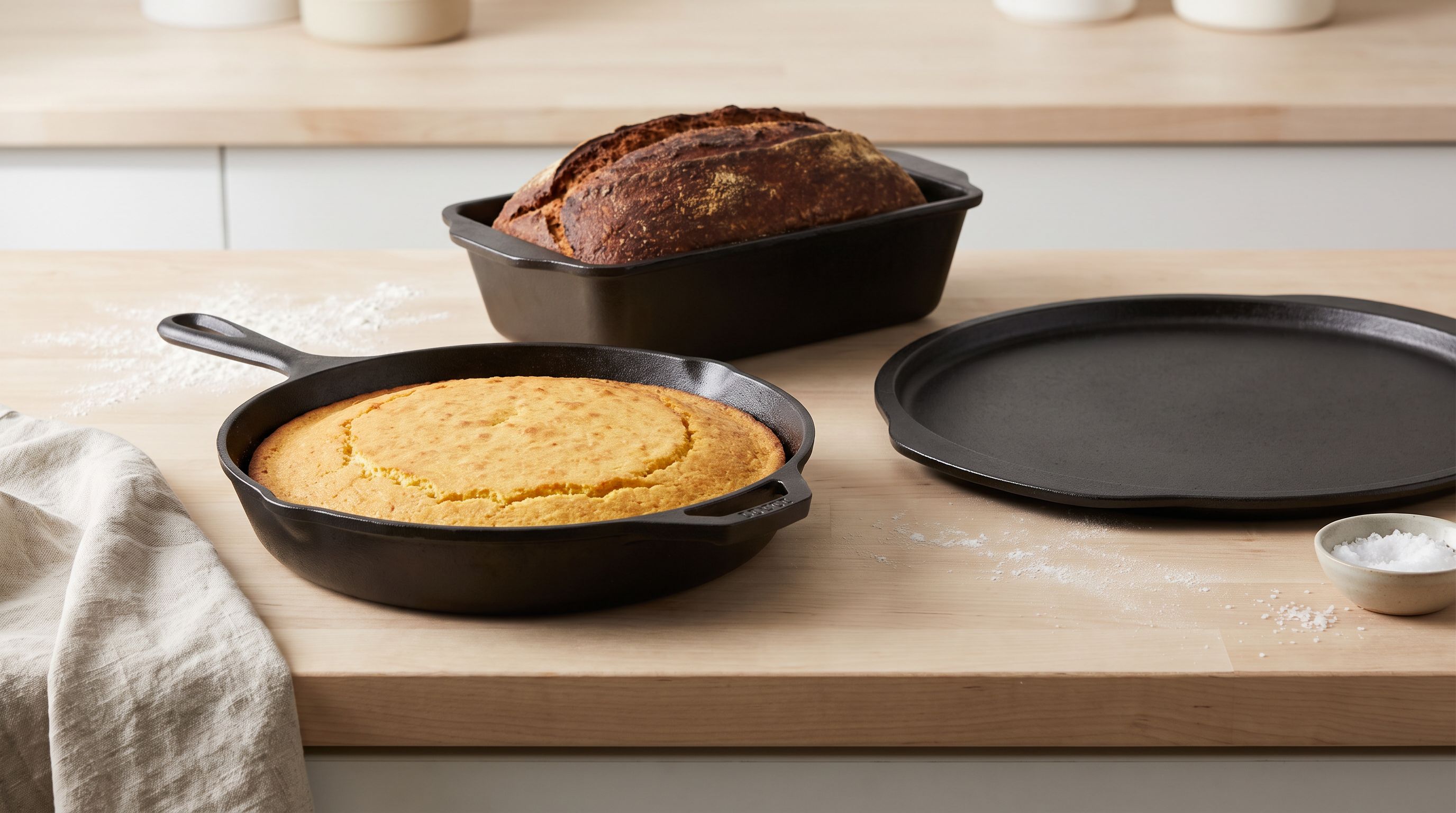
A 10.25-inch skillet is the default, and the Lodge 10.25 Inch Cast Iron Skillet remains the sensible answer — it's the pan independent reviewers across the board keep landing on for value, and at roughly 5 pounds it has plenty of mass for a crackling cornbread crust. Preheat it with fat in the oven, pour batter into the sizzle, and you get the brown lace edge that defines Southern-style cornbread.
 Best overall for cornbread · Lodge 10.25 Inch Cast Iron Skillet — Check price on Amazon →
If you want something easier to move in and out of a hot oven, the Lodge Chef Collection 12 Inch Cast Iron Skillet is milled thinner with a flared, lighter body. Wirecutter picked it as their overall cast-iron skillet after testing 16 pans. You trade a little thermal mass for real-world handling, which matters more than purists admit when the pan is at 450°F.
 Best for handling · Lodge Chef Collection 12 Inch Cast Iron Skillet — Check price on Amazon →
Loaf pans
Cast iron loaf pans produce a crust that steel simply cannot: dark, thick, slightly chewy sidewalls. The Lodge Cast Iron Loaf Pan is the widely available option, and it's excellent for sandwich loaves, banana bread, meatloaf, and pâté. Expect longer preheat and slightly longer bake-through for dense batters — the sides set fast while the center lags.
 Best loaf pan · Lodge Cast Iron Loaf Pan — Check price on Amazon →
The caveat: sticky, sugary quick breads need a genuinely well-seasoned pan or a parchment sling. Cast iron's seasoning is not nonstick in the PTFE sense, and a banana bread with a pound of fruit in it will test it.
Pizza and flatbread
For pan pizza and deep-dish, a cast iron skillet or a dedicated round pan beats a stone because the sidewalls fry the cheese edge. For Neapolitan-style and thin crust, a steel or iron flat surface wins — the Lodge Pro-Logic Cast Iron Pizza Pan gives you a preheatable flat disc that transfers heat faster than ceramic stone and won't crack from thermal shock. Baking steel is still the king of thin-crust undercarriage, but cast iron is close, cheaper, and doubles as a griddle.
 Best pizza pan · Lodge Pro-Logic Cast Iron Pizza Pan — Check price on Amazon →
And for hearth loaves, the enameled route is worth the money: the Le Creuset Signature Round Dutch Oven 5.5 Qt traps steam for the first half of the bake, which is what gives you a glossy, blistered crust without a steam-injection oven. Measure your rack clearance first.
 Premium pick for bread · Le Creuset Signature Round Dutch Oven 5.5 Qt — Check price on Amazon →
Comparison table
| Pan type | Approx. weight | Preheat time (to 450°F) | Rack clearance needed | Best for | Worst for |
|---|---|---|---|---|---|
| Cast iron skillet, 10–12 in | ~5–8 lb | 15–20 min | Low — fits any rack | Cornbread, focaccia, pan pizza, cobbler | Delicate cakes, acidic fruit on bare iron |
| Cast iron loaf pan | ~5–6 lb | 15–20 min | Low | Sandwich bread, meatloaf, dense quick breads | Sticky, high-sugar batters without parchment |
| Cast iron pizza pan (flat) | ~8–10 lb | 20+ min | Low, but needs full-width rack | Pan pizza, flatbread, reheating slices | Launching wet Neapolitan dough |
| Enameled Dutch oven, 5.5 qt | ~11–13 lb | 25–30 min with lid | High — 7–9 in with lid | No-knead boules, sourdough | Anything you need to lift one-handed |
| Aluminized steel pan | under 1 lb | 5 min | Low | Layer cakes, cookies, even bakes | Deep bottom browning |
| Ceramic/stoneware | ~3–5 lb | 20 min | Moderate | Casseroles, gratins, crisps | Thermal shock; crack risk |
Bare vs. enameled for baking
Bare cast iron browns harder and costs less, but reacts with acid — tomato-heavy pizza sauce, lemon, buttermilk left sitting — and needs drying and occasional re-oiling. Enameled iron is non-reactive, needs no seasoning, is dishwasher-tolerable (hand wash anyway), and releases sticky batters more predictably. It also browns slightly less aggressively because enamel is a glass layer between the iron and your food.
For bread baked in a covered pot, enameled is the better buy. For cornbread and pan pizza, bare iron is better and cheaper.
Care that actually matters for bakeware
- Preheat empty, with the oven, not on a ripping-hot burner. Uneven stovetop heat warps nothing but it does scorch seasoning.
- Add fat to the pan before the batter, while the pan is hot. That sizzle is the crust.
- Don't soak. Hot water, stiff brush, dry on a warm burner, thin wipe of neutral oil.
- Acidic batters (lots of buttermilk, fruit, tomato) are fine for the length of a bake on well-seasoned iron. Storing leftovers in the pan is not.
- Chainmail scrubbers work; dish soap in normal amounts does not destroy seasoning.
Who should skip cast iron bakeware
If you bake chiffon cakes, macarons, or tender layer cakes, buy aluminized steel and spend nothing on iron. If you have wrist or shoulder issues, a 12-pound Dutch oven coming out of a 500°F oven is a genuine hazard — a lightweight enameled steel roaster with a lid gets you 80% of the crust at a third of the weight. And if your oven racks are shallow or your oven is a compact 24-inch model, measure before you fall in love with a 7-quart pot.
FAQ
Do I need to season a new cast iron loaf pan before baking? Most Lodge bakeware ships pre-seasoned and is usable immediately, but two or three fatty bakes build it up fast. Wipe a thin coat of neutral oil and bake at 400°F for an hour if you want a head start.
Can I put cast iron bakeware on an induction hob? Yes — bare and enameled cast iron are both fully induction compatible. Flat-bottomed pans couple best; warped or footed bakeware may not register.
How long should I preheat a cast iron pan for pizza? Give it at least 20 minutes at your oven's maximum after the oven itself signals ready. Oven preheat alarms fire long before the mass inside is at temperature.
Is a baking steel better than a cast iron pizza pan? For thin, high-hydration crusts, yes — steel's conductivity is higher and it's usually larger. For pan pizza with a fried cheese edge, cast iron wins outright.
Will cast iron crack like a pizza stone? No. Thermal shock cracks ceramic; iron tolerates it. Enamel can chip from impact, but it won't shatter from a temperature swing.
Does cast iron make bread rise more? Indirectly. The stored heat drives faster oven spring in the first few minutes, and a lidded pot traps steam that keeps the crust pliable while it expands. Both effects are real and both favor heavy iron.
Our picks
Lodge Pre-Seasoned Cast Iron Skillet with Hot Handle Holder, 10.25 Inches
Roughly five pounds of preheat mass for a lacy brown cornbread edge, at the lowest price in the category.
Lodge Chef Collection 12 Inch Pre-Seasoned Cast Iron Skillet, Perfect Sear
Milled thinner and lighter than classic Lodge, so a 450°F pan is far easier to move in and out of the oven.
Lodge Pre-Seasoned Cast Iron Loaf Pan, PFAS-Free, 10 Inches
Dark, chewy sidewalls on sandwich loaves and meatloaf that aluminized steel simply can't produce.
Lodge BOLD Pre-Seasoned Cast Iron Pizza Pan with Handles, 14 Inches
A preheatable flat iron disc that beats ceramic stone on heat transfer and won't crack from thermal shock.
Le Creuset Enameled Cast Iron Round Dutch Oven, 5.5 qt., Flame
Enameled, non-reactive and steam-trapping — the simplest route to a blistered sourdough crust at home.
Get the best kitchen gear deals in your inbox
Join the PrepDeck newsletter for hand-picked kitchen gear deals and new buying guides. No spam, unsubscribe anytime.
Related reads
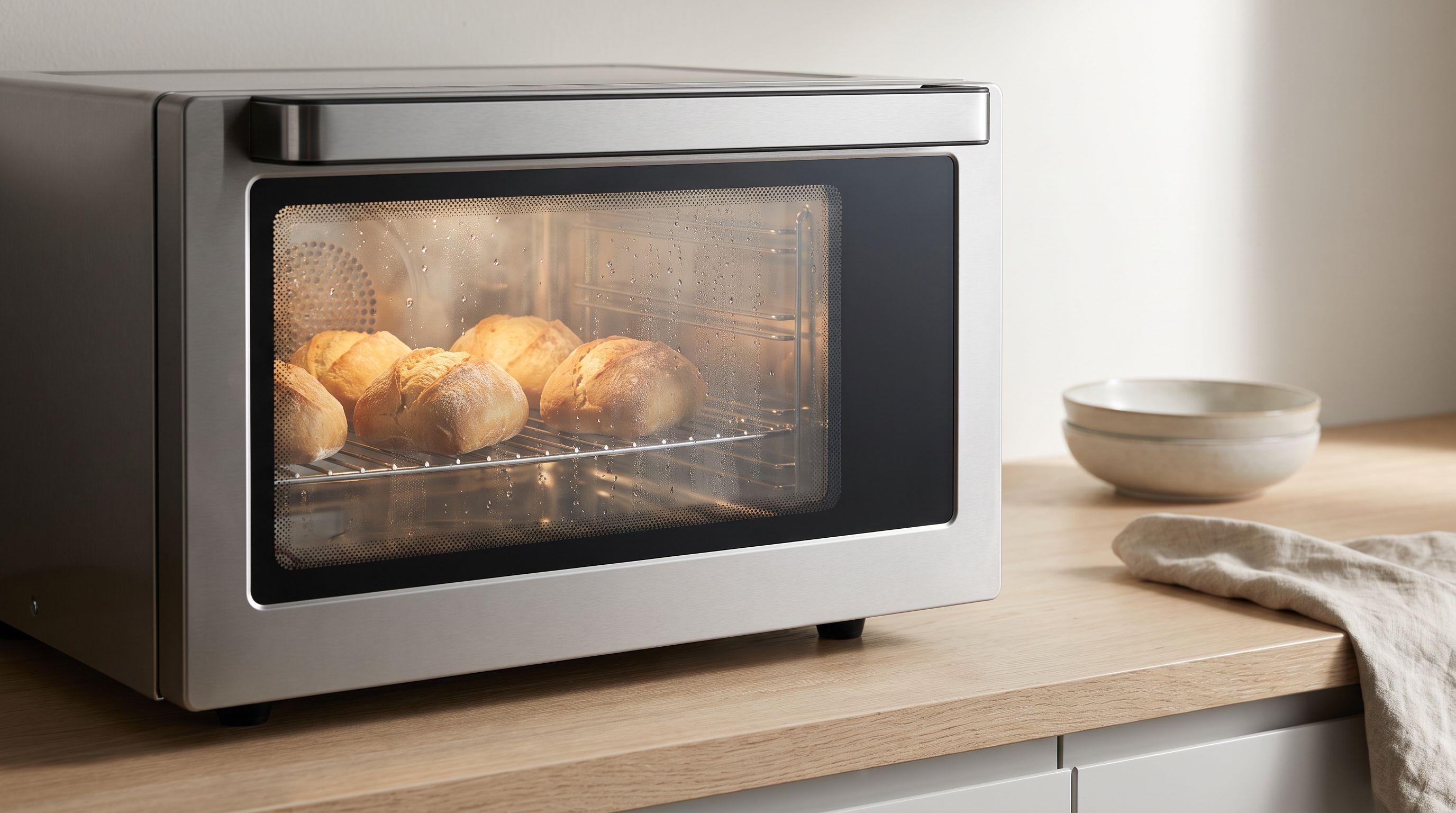
Countertop Steam Oven 2026: Does Steam Beat Convection?
A countertop steam oven 2026 buying guide ranked by cavity size, water tank capacity, and whether combi-steam actually earns its price over a good convection oven.
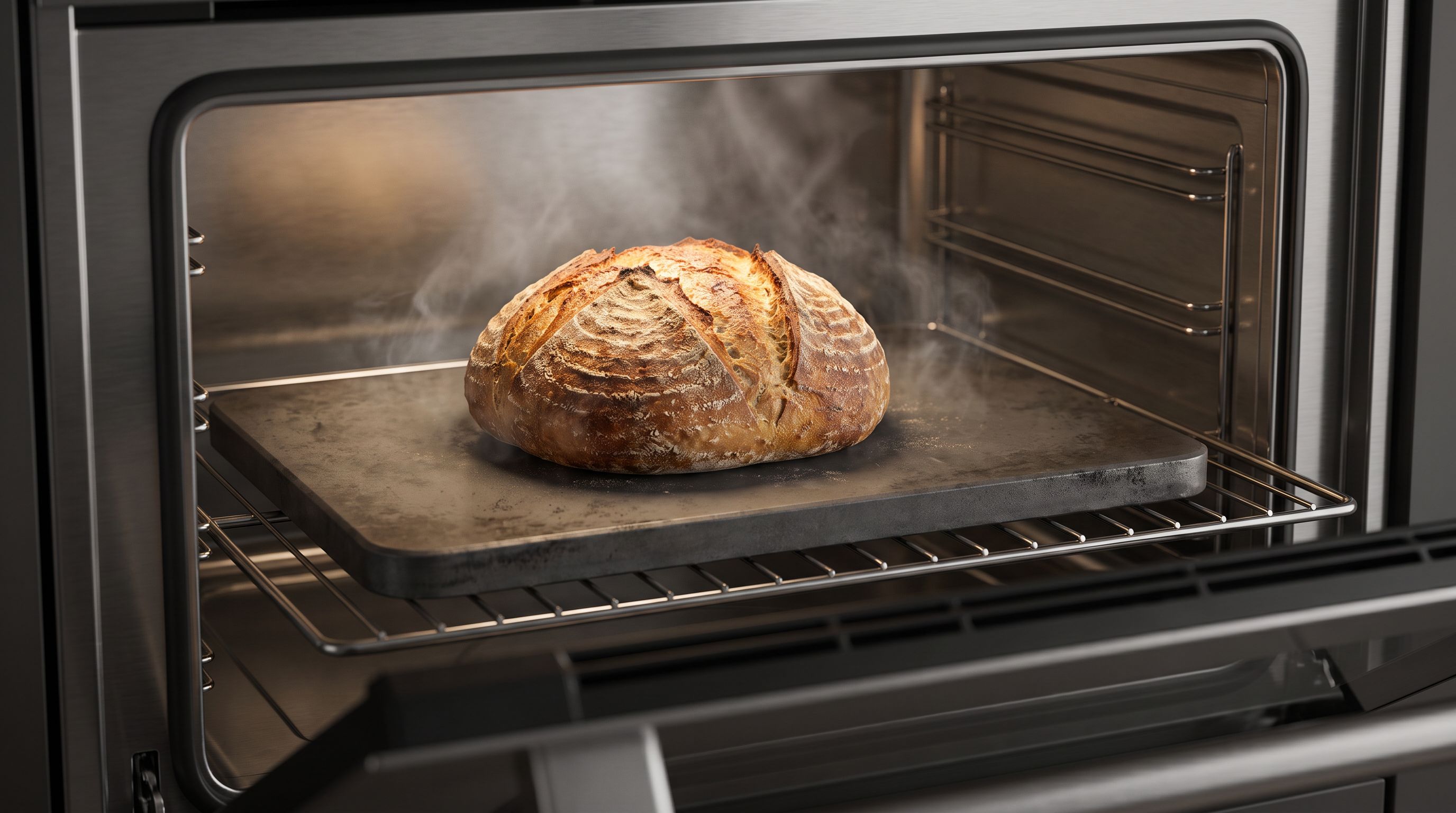
Baking Steel for Bread in 2026: Fit It to Your Rack First
A baking steel for bread lives or dies on fit. Measure your rack, pick a thickness your oven can preheat, and see which 2026 steels suit sourdough and pizza.
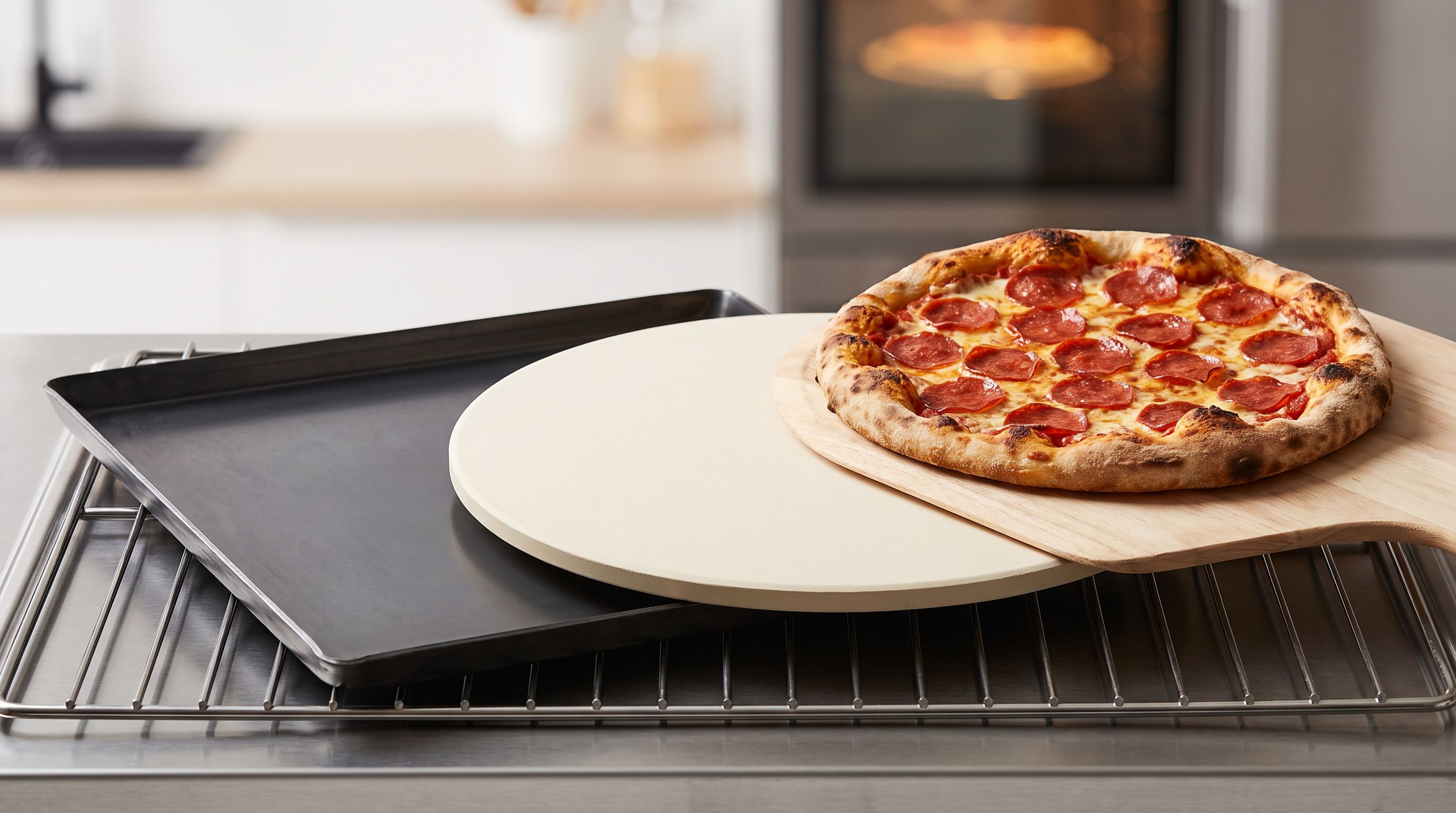
Pizza Steel vs Stone in 2026: Pick One That Fits Your Oven
Pizza steel vs stone in 2026: how thickness, mass and rack clearance change your crust — plus picks sized for standard 30-inch home ovens.